
Last updated
What does creative automation actually look like in 2026?
It’s no longer just about producing assets faster. As campaigns become more complex and omnichannel by default, creative automation is starting to shape how creative is planned, adapted, and optimized over time.
Main Shifts in Creative Automation in 2026
These are the key shifts redefining creative automation in 2026, and what they mean for teams running modern digital campaigns.
Automation moving from support to strategic creative engine
Creative automation is becoming the engine behind omnichannel campaigns. Long gone are the days of omnichannel campaigns being an option. Omnichannel strategies are now crucial for advertising campaigns. At the same time, they are complicated and resource-heavy. Or, that used to be the case, before creative automation stepped up.
Creative automation platforms give companies who use them a hugely-needed advantage: they can help teams plan and deploy large-scale omnichannel campaigns without having to adjust their structure or resources. How does it do that?
Creative automation platforms:
-
ensure consistency across formats and markets
-
keep creatives refreshed and prevent ad fatigue
-
sequence variations to match channel context, streamlining the funnel journey, and
-
bridge the gap between creative and performance teams by providing insights into ad performance both on an isolated level per creative, and the campaign as a whole
Instead of simply “making more assets faster,” creative automation now shapes how campaigns are built: modular creative systems, reusable components, and brand-safe structures that allow teams to experiment more without losing control.
How Bannerflow can help you
-
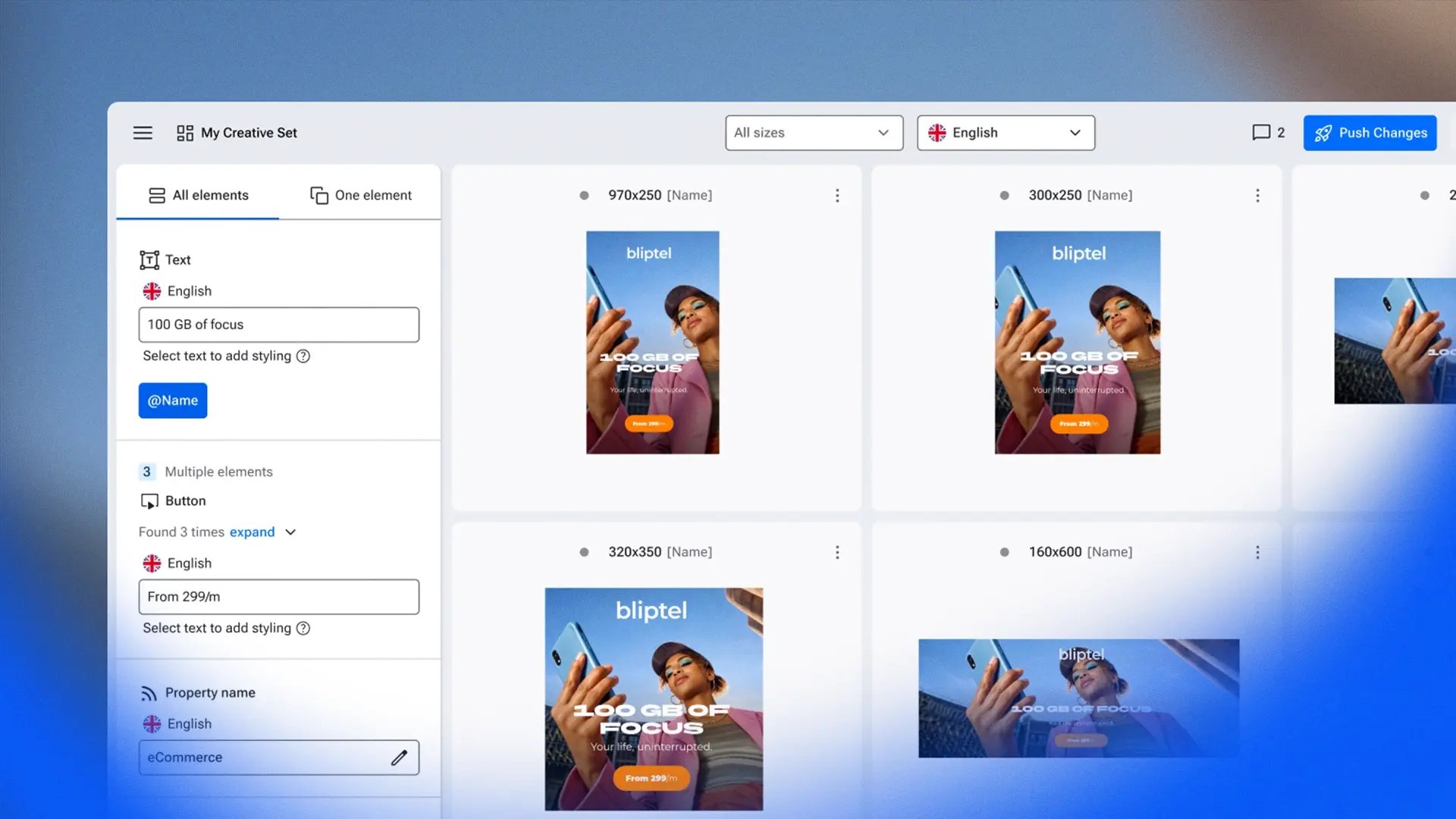
Bannerflow uses modular design systems that let teams build once and adapt everywhere - across markets, languages, channels, and formats.
-
Creative guardrails and brand-safe components give designers and marketers a shared framework, turning Bannerflow into the hub where creative strategy and execution connect.
-
Instead of scattered assets, Bannerflow centralises everything, ensuring consistency and accelerating collaboration across teams.
This shifts creative automation from a production helper into the foundation of your campaign system.
Scale of creative output with generative AI & personalization
AI isn’t replacing creative teams, but it is redefining output. Just as a creative automation tool is not meant to replace the creative power of your team, AI isn’t here to do that, either. But creative automation and AI tools, combined, can deeply enhance your campaign performance. So, if you haven’t invested in AI tools, this is the time to do it.
In 2026, leading brands are using creative automation in combination with AI tools to:
-
generate first drafts and concept variations
-
localize content instantly
-
tailor messaging for micro-audiences, and
-
create iterative creative cycles based on live campaign data
The combination of creative automation and AI allows teams to deliver personalized experiences at a scale that was impossible manually. This makes creative automation a competitive advantage, not an efficiency upgrade.
How Bannerflow can help you
-
Bannerflow’s AI-assisted tooling helps teams ideate, version, adapt copy, and generate creative variations faster, all within brand rules.
-
Dynamic feeds and localization tools allow campaigns to automatically adjust for markets, languages, or product changes.
-
Smart templating means teams can personalize creative at scale without repetitive manual work.
First-party data prioritization
With cookies disappearing and targeting signals shrinking, first-party data is becoming the fuel that powers creative decisions. The question is no longer who you can target: it’s what creative experience you can deliver based on the signals you do have.
Creative automation tools increasingly connect with CRM systems, CDPs, and consent-based audience profiles to tailor creative variations automatically. This shift means:
-
messaging adapts to known behaviors,
-
offers adjust based on lifecycle stage,
-
creative speaks to real user needs instead of assumptions
In 2026, the brands that thrive are the ones linking data to creative to delivery in a single, continuous loop.
How Bannerflow can help
-
Bannerflow integrates with data feeds, CRM systems, and product catalogues, enabling creative variations driven by real-time, consented user signals.
-
Teams can build data-driven creative rules: messaging that adapts by audience segment, lifecycle stage, or market context.
-
This turns first-party data into a creative advantage, not just a targeting one
Real-time optimization, adaptive creative, and predictive analytics
In 2026, creative performance is no longer something teams review after a campaign has run. It’s something campaigns respond to as they’re live. As media environments become faster, more fragmented, and more competitive, static creatives simply can’t keep up.
This is where creative automation evolves again. Instead of supporting production or enabling versioning, it becomes the foundation for adaptive creative systems: campaign setups that continuously learn, adjust, and optimize based on real-world signals.
Expect creative automation tools to evolve into adaptive creative systems, where creative elements dynamically change based on:
-
live engagement signals
-
channel performance
-
contextual cues (weather, time of day, location)
-
device behaviour, or
-
audience stage in the journey
Instead of creating hundreds of static variants, teams build modular frameworks where the system assembles or adjusts creative automatically. Add predictive analytics to this, and platforms begin surfacing which variations are likely to perform best before launching them.
This is the next major shift: creative that optimizes itself, not just creative that scales
How Bannerflow can help you
-
Bannerflow supports dynamic creative rules, allowing assets to automatically update based on signals like device, location, weather, inventory, or engagement trends.
-
Built-in performance reporting shows which variations fatigue fastest and which elements (headlines, visuals, CTAs) drive impact, helping teams refresh before performance drops.
-
The platform provides a foundation for predictive and iterative optimization, enabling faster tests, faster learnings, and continuously improving creatives.
The outcome is an adaptive creative system that evolves with your audience in real time, not hours or days later.
Conclusion
Creative automation has moved on. What started as a way to speed up production is turning into a necessary technology to help brands separate themselves from the ‘brand noise’ and earn the audience’s attention.
Across AI, personalization, first-party data, and real-time optimization, the common thread is clear: creative needs to be flexible, data-aware, and able to adapt while campaigns are live. Static setups and one-off executions can’t keep up anymore.
That’s where creative automation platforms like Bannerflow come in: not as production tools, but as the foundation for scalable, adaptive creative. By connecting strategy, creatives, and performance in one system, teams can move faster, stay consistent, and keep improving without adding complexity.
The brands that lead in 2026 will be the ones treating creative as a system, not a deliverable.