
Last updated
What do the Olympics, the Superbowl, and the FIFA World Cup have in common for marketers? In advertising, that’s one of the easiest questions to answer. Major sports events pose an opportunity for brands to ‘up their game’, as they can leverage them to create some of the most impactful advertising campaigns of the year.
How to leverage major sports events for your ad campaigns
Global tournaments, championships, finals, as well as multi-week events create massive spikes in audience attention. But at the same time the window of opportunity is short, and the creative competition is usually massive. Leveraging an event doesn’t matter if you don’t do it right. In this article, you’re going to learn how to create an ad campaign that maximizes your ROI during a major sports event. You’re going to get practical tips, how-tos, and you’ll see some real examples of brands in action.
Run team-specific frequency control instead of campaign-level frequency
When it comes to ad campaigns that leverage major sport events, controlling campaign-level frequency is not enough. In major sports events, audience fatigue doesn’t happen at the brand level, but at the team level. Team fans consume far more content around the team they support than casual viewers. This comes with a caveat: consuming ads faster means the audience also burns out on the same creative much faster. Creative fatigue is therefore much more frequent in campaigns exposed to major sports events. But running team-specific frequency control helps you prevent that.
Here’s how major brands do audience segmentation right: instead of setting a limit to the appearance of creatives in general, they go one step further and control how often a creative appears to specific audience segments. Let’s see how this works:
Start by segmenting your audience per team. These are going to be your audience segments. And each one will have different exposure thresholds. At this stage, it’s important to also create a team-neutral audience segment for those not supporting one specific team.
For every major ad creative you want to use, make an audience-specific creative variant. For the creatives that will speak to specific team supporters, consider altering in a way that is more personalized to them, while keeping the team-neutral segment’s creatives less personalized.
Now it’s time to set frequency exposure for your audience segments. Instead of controlling how often someone sees any ad from the campaign, control exposure per team-linked creative variant. What does that mean in practice?
Let’s say you have a football match. Having created three audience segments (Team A fans, Team B fans, team-neutral viewers), and the respective creatives (let’s call them Team A creative, Team B creative, team-neutral creative), you set the frequency of the creative viewing. For example:
A fan of Team A might see:
Team A creative 2–3 times
Team B creative once or not at all
A team-neutral viewer might see:
Multiple team creatives without fatigue
This setup allows you to cap exposure where repetition happens fastest (team-aligned fans) without restricting delivery across the rest of the audience. Team-specific creatives can be paused, rotated, or scaled independently as performance changes, while neutral creatives can continue to absorb reach. This way, you isolate creative fatigue instead of spreading across the campaign. What’s more, you can take optimization decisions based on audience segment data instead of on averaged campaign data.
In practice
To apply team-specific frequency control in practice, you need to look beyond audience segmentation and consider how creatives are structured and delivered. Team-specific creatives must function as independent delivery units, not as interchangeable variations within a rotating group, otherwise frequency limits will still not work at campaign level.
Just as importantly, frequency thresholds should reflect audience intensity. Highly engaged team fans require lower caps and faster creative rotation, while team-neutral audiences can tolerate higher repetition across variants. Without accounting for these differences, frequency control defaults to an “average viewer” model that simply doesn’t exist during major sports events.
Team-specific frequency control in action: Nike, Write the Future (2010 FIFA World Cup)
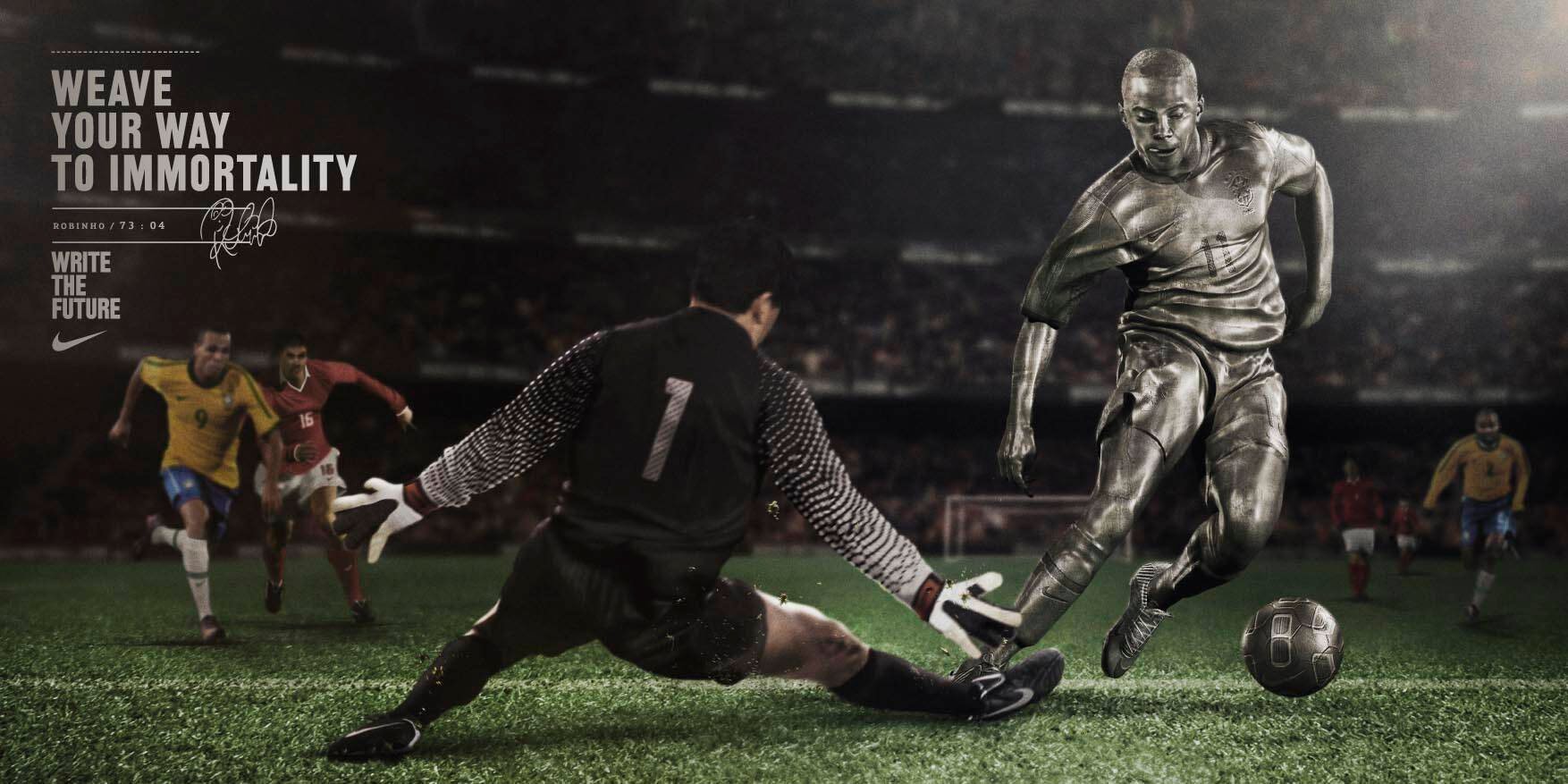
Nike, Write the Future campaign
A clear illustration of this approach can be seen in Nike’s Write the Future campaign during the 2010 FIFA World Cup. Instead of relying on a single global execution, Nike produced tailored edits that centered on different hero players depending on the market: Cristiano Ronaldo in Portugal and parts of Europe, Wayne Rooney in the UK, and other players elsewhere.
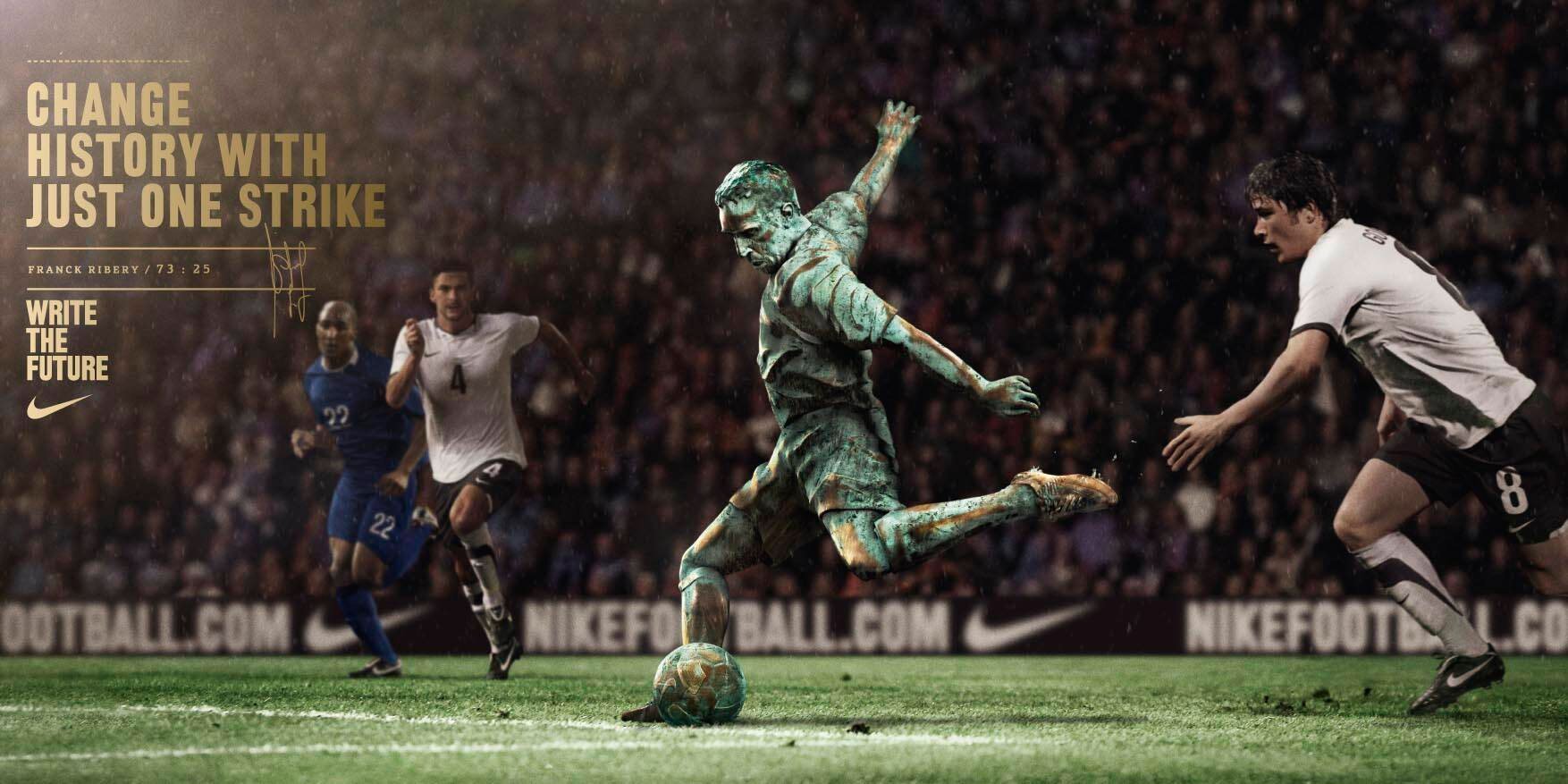
Nike, Write the Future campaign
While the campaign was unified under one narrative, each edit functioned as a distinct creative experience for fans of specific teams and players. This separation ensured that highly engaged fan segments were repeatedly exposed to the creative most relevant to them, without overloading audiences with unrelated team narratives. In practice, this mirrors the principle of treating team-aligned creatives as independent delivery units rather than interchangeable variations - allowing relevance to scale without accelerating fatigue among core fan bases.
Switch creative tone based on match timing, not funnel stage
Matching the creative tone to traditional funnel stages doesn’t work when it comes to major sports events. That’s because funnel logic assumes stable intent over time. But sports events create compressed emotional cycles. And that’s something you need to both adjust and take advantage of.
Here’s how match timing works: instead of locking creative tone to upper-, mid-, or lower-funnel stages, align it to event timing states. This allows the same audience to receive messaging that matches their mindset as the event unfolds, without fragmenting delivery or duplicating campaigns. In practice, this typically means defining three distinct creative states in advance:
-
Pre-match: Building anticipation and momentum, leaning into buildup, rivalry, and expectation.
-
Live match: Maximizing presence with urgency and restraint, reducing copy and focusing on immediacy rather than persuasion.
-
Post-match: Responding to emotion, whether that’s celebration, relief, or disappointment, and reintroducing clearer messaging once attention stabilizes.
In practice
Creative tone needs to be built as a modular layer that can be switched without rebuilding the underlying creative or relaunching campaigns. Define match-timing states before the event, with approved copy, visual intensity, and messaging depth mapped to each state so teams aren’t making judgment calls during live moments.
It’s important to apply tone changes quickly and consistently across all active channels and formats. If updates require new builds, re-approvals, or channel-by-channel publishing, teams will default back to static funnel messaging and miss the narrow windows where attention is highest.
Adjusting creative tone based on match timing in action: Beats by Dre – The Game Before the Game (World Cup)
A clear example of this approach is Beats by Dre’s The Game Before the Game campaign around the FIFA World Cup. Instead of aligning its creative to traditional funnel stages, Beats focused entirely on the pre-match window: the period when anticipation peaks and attention is naturally high. The creative centered on players’ pre-game routines and mental preparation, deliberately matching the audience’s mindset before kickoff rather than trying to drive urgency or conversion.
By anchoring the campaign to a specific match-timing state and letting it live there, Beats avoided forcing the same message across moments where it would feel out of sync. The result was creative that felt relevant to the moment it appeared in — not to a generic stage in the funnel.
Use negative outcomes as retargeting triggers
Most campaigns treat negative outcomes (losses, eliminations, missed moments) as an endpoint. In major sports events, they’re not. Fans don’t disengage after a loss. In fact, they often become more emotionally reflective, frustrated, or loyal, which creates a distinct post-loss attention window that brands usually ignore.
Instead of stopping or neutralizing messaging after a negative outcome, use it as a signal to shift messaging, not end it. Loss, elimination, or disappointment becomes a trigger for a different creative state, delivered to already engaged audiences.
In practice
To apply this effectively, negative outcomes must be treated as explicit creative states, not edge cases. Loss, elimination, or missed qualification should each trigger a predefined post-loss creative pathway with its own tone, messaging rules, and lifespan. These states need to be approved before the event begins, so teams aren’t forced to improvise or pause campaigns when outcomes turn negative.
Post-loss creatives should reduce pressure rather than increase it. Immediately after disappointment, audiences are still emotionally engaged but less receptive to urgency-led messaging or hard conversion prompts. Shift toward supportive, loyalty-driven, or reflective messaging to maintain relevance without accelerating disengagement.
Timing is critical. Post-loss retargeting windows should be short and intentional, typically limited to the immediate aftermath of the event. The goal isn’t prolonged exposure, but to acknowledge the moment while attention is still high, then transition out before fatigue or indifference sets in.
Finally, winning and losing pathways must be mutually exclusive. Audiences should never receive celebratory or neutral event messaging once a team or athlete has been eliminated. Clear separation between post-win and post-loss creative states is essential to avoid emotional mismatch, which is one of the fastest ways to erode trust during major sports events.
Using negative outcomes in retargeting: Adidas – All In or Nothing (2014 World Cup)
For the All In or Nothing campaign that leveraged the 2014 FIFA World Cup, Adidas built multiple narrative arcs around players and teams, including the risk of failure.
Rather than centering its creative exclusively on victory, Adidas built a narrative that acknowledged risk, pressure, and the possibility of failure as inevitable parts of competition.
As teams were eliminated, the campaign didn’t simply disappear or continue with generic tournament messaging. Instead, the messaging shifted toward commitment, resilience, and staying “all in” despite the outcome. Adidas’ experiment showed that negative outcomes aren’t endpoints, but signals to change the message. By adapting creative tone in response to elimination rather than treating it as a stop condition, Adidas maintained relevance with emotionally invested audiences at the moment when attention typically drops.
Scale matchups, not teams
During major sports events, audience attention isn’t distributed evenly around all teams and all players. Fans tend to focus more on specific matches between teams with known rivalries, or even players that tend to experience the competition more in contrast to the rest of them.
In practice, this means one more audience segment you can leverage: the people tuning in for the rivalry instead of the team itself. Rivalry is a great driver of attention in sports events, and here is how you can leverage it:
In practice
To scale matchups effectively, the matchup itself must be treated as an independent creative unit with its own narrative and lifespan. Each pairing needs a dedicated variant that reflects its specific stakes and context. The creatives must activate only when the matchup becomes relevant and expire immediately after it concludes. Once one side is eliminated, the matchup no longer exists. Retire its creative instantly to preserve relevance and maintain clean performance data.
Scaling matchups in practice: Reebok’s Dan & Dave Olympic build-up
A clear example of scaling a matchup rather than individual athletes is Reebok’s Dan & Dave campaign ahead of the 1992 Barcelona Olympics. Instead of promoting Dan O’Brien and Dave Johnson separately, Reebok framed the entire campaign around their rivalry and the question of which decathlete would win Olympic gold. The creative wasn’t about isolated performance or generic Olympic sponsorship. It was about the head-to-head tension between two competitors. By building anticipation around a specific confrontation, Reebok turned the matchup itself into the narrative engine of the campaign. This illustrates the principle behind scaling matchups: attention increases when creative reflects opposition and stakes, not just athlete presence.
React faster than broadcasters, not competitors
When it comes to running campaigns during sports events, your baseline is not the competitors - it’s the broadcasters. During peak moments of a match, can you react faster than the commentary? That’s where you’ll be winning attention.
Your goal is to have relevant creatives live while the moment is still forming, not following the replay. For that to be leveraged, you need a few things in place. Create pre-approved creative states so you switch messaging instead of building from scratch when a ‘moment’ happens. Ensure that once activated, creative changes propagate instantly across all relevant formats and markets. And make sure you keep publishing and updating workflows as lightweight as possible - you have a short time window, and you need your processes to be easily manageable.
In practice
Build a set of pre-approved creatives based on probable live scenarios: a touchdown, an elimination, a record-breaking moment, so you can react faster when they happen. During key sports events, assign an owner who will have decision-making authority, so you remove a layer of delays. And make sure that once applied, changes are deployed instantly across all active placements - now is not the moment to ignore automation.
Reacting to the ‘moment’: Oreo – “You can still dunk in the dark” (Super Bowl XLVII, 2013)
When the lights went out during the 2013 Super Bowl, Oreo didn’t wait for commentators to explain what was happening. Within minutes, it published a simple visual: “You can still dunk in the dark.” The timing was key. The post appeared while the blackout was still unfolding, not after the recap. That timing is what made it powerful.
Oreo wasn’t competing with other advertisers; it was running against the clock. The creative worked because it entered the live attention window before the narrative settled. And that was a clear example of reacting inside the moment, not commenting on it later.
Use visuals instead of text during live matches
During high-stake matches, your creative is competing with the game itself. That’s because audience focus is scarce, and fans aren’t reading: they’re reacting. Their attention shifts between the broadcast, social feeds, and live conversations rapidly. In that environment, copy-heavy messaging becomes invisible. If your creative requires explanation, it’s too slow. You need to use visual signals like score states, color shifts, player imagery, motion, which can carry the message without relying on text to clarify it.
In practice
To make visuals carry the message during live matches, design creatives that communicate in under a second. Build modular visual elements (score overlays, color states, momentum indicators, badges, timers) that can update instantly without rewriting copy. Limit ad text to a single line at most, and make sure the core meaning survives even if no one reads it. Test creatives at reduced sizes and fast scroll speeds to confirm they register at a glance.
Using visuals in action: The Red Bull Stratos Project
During the Red Bull Stratos jump, the image did all the work. A single visual, Baumgartner standing at the edge of space, represented the brand messaging instantly. Red Bull didn’t rely on copy to explain the moment. The live footage and stills were clear enough to stand on their own. In a high-attention, live environment, that visual clarity made the creative universally readable across screens and formats.
Build moment hooks that expire in hours
Don’t waste your campaign on running creatives that linger long after the moment has passed. Instead, design and build “moment hooks” to live briefly and disappear deliberately. These hooks should tie directly to a specific, time-restricted event: kickoff, halftime, medal ceremony, etc. Their power comes from being specific and scarce. When audiences know the message is tied to this exact window, engagement increases.
In practice
Define the possible high-impact moments before the event begins: kickoff, medal ceremony, half time, etc. Make sure to have preapproved creative templates ready to kick off when the moment is happening. Remember: you’re not supposed to be building the creative at that time - only adjusting and publishing it, fast.
Set a clear timeframe for each of these creatives: it should go live when the moment starts and retire when the moment ends - no lingering. Design the creative to feel temporary: use countdowns, live score references, limited-time messaging or visual cues that signal immediacy.
Building moment hooks: Wimbledon – In Pursuit of Greatness
Wimbledon’s In Pursuit of Greatness campaign illustrates how moment-focused creatives can be tied to a specific live window. On championship days and finals week, Wimbledon activates time-bound visuals and videos that communicate the drama and stakes of the moment. The imagery works instantly across digital and social formats because it’s built around this match and day, not evergreen messaging. These time-sensitive creatives are designed to peak during the live event and recede once the Championships conclude, highlighting how defining and retiring moment hooks around specific hours deepens audience engagement.
Wimbledon, 'In Pursuit of Greatness'
Adapt brand presence by sport maturity
Sport maturity should influence how prominently you show up. In highly mature sports, audiences expect bold sponsorship, visible branding, and performance-driven messaging. This means your brand can take up space. In emerging or niche sports, the dynamic is different. Audiences are often more community-focused and authenticity-sensitive, and heavy branding can feel out of place. Brands that apply the same level of visibility everywhere risk either blending into saturated markets or overpowering developing ones.
In practice
Define brand intensity levels before you activate your creatives. Create a high-visibility mode for mature, sponsor-heavy sports and a more restrained mode for emerging or community-driven ones. This affects visual dominance, animation, product focus, and how direct your call to action is. In established sports, scale presence with confidence. In developing ecosystems, prioritise relevance and integration over volume.
Finally, evaluate performance within each sport’s context. What works in a saturated environment may feel excessive in a growing one. Adapting brand presence is about calibrating visibility to audience expectations, not changing who you are as a brand.
Adapting brand presence by sport maturity: Puma in Premier League vs Puma in Running Communities
Puma doesn’t show up the same way everywhere. In the Premier League, a mature and sponsor-heavy environment, branding is bold and highly visible. Kits, broadcast exposure, and performance-led creative reflect an ecosystem where strong commercial presence is expected.
In running and community athletics, the tone shifts. Campaigns focus more on participation and culture, with branding integrated rather than dominant.
The brand stays consistent, but the intensity adapts. In mature sports, visibility drives impact. In community-led environments, restraint builds credibility.
 From Puma's 'Rise, run and 'go wild' for the 5am' campaign
Winning the moment in major sports events
Major sports events don’t reward brands for simply showing up. They reward those who understand how attention shifts in real time.
Emotions spike, loyalty intensifies, and fatigue accelerates. To win in this environment, you need to control frequency where it actually matters, align creatives to match timing instead of funnel stages, react inside the moment, and design messaging that expires as quickly as the attention around it.
When you build campaigns that move with the rhythm of the event, not against it, you turn short attention spikes into measurable impact, and moments into ROI.