
Last updated
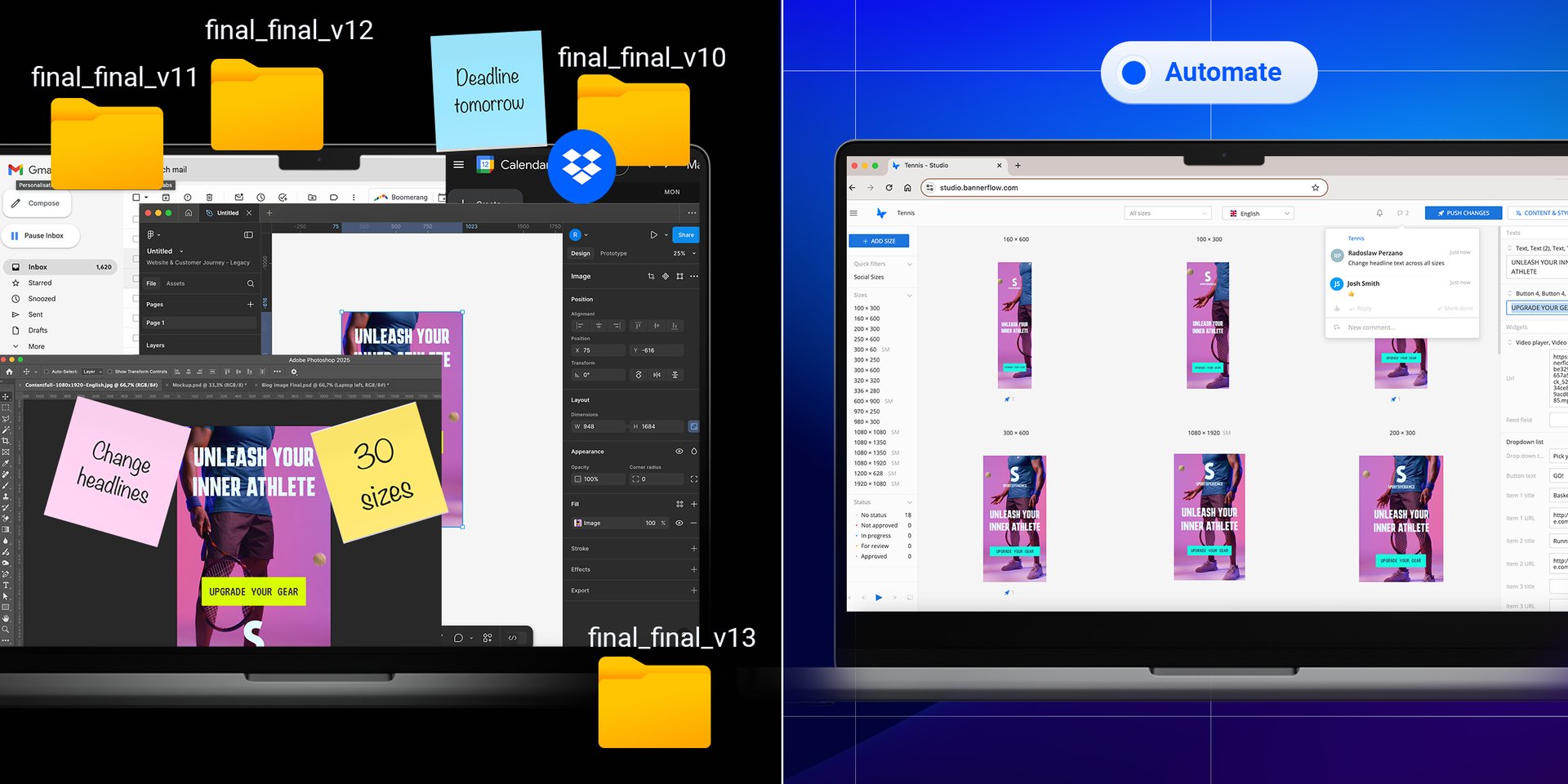
Creative automation is software that builds many versions of an ad from one master design. Instead of hand-making every size, language, and variant, you set up a template once, and the platform generates the rest. It automates production work, not creative judgment: people still decide what the ad says and whom it targets.
Why creative automation matters now
Budgets are tight, targets are higher, and audiences now expect messaging shaped to them on whichever channel they happen to use. Meeting that by hand means volume. A campaign across five markets in ten sizes and four formats is 200 creatives before anyone translates a word of copy.
Mobile makes the point concretely: a mobile banner needs different sizing and copy discipline than the same campaign's display banner counterpart, and a team building both by hand is doing the work twice for one campaign.
Most creative teams are already past what manual production can absorb, and the symptom shows up in the calendar rather than the workload. Campaigns that should go out in days take weeks, because every format and every market is a separate build. We've mapped the seven places that the bottleneck actually shows up in: 7 Creative Production Bottlenecks.
Creative automation is how teams close that gap without hiring for it.
What is creative automation?
Creative automation refers to tools that produce ad creative at scale from a single master design.
Teams use it for the mechanical parts of production: resizing, re-versioning, translating, rebuilding the same concept for a different placement. When a campaign needs forty variations of one idea, none of that work needs a human brain on it.
The name puts people off, and it shouldn't. Creative automation doesn't automate creativity. It removes the drudgery so designers and copywriters spend their time on the part that needs judgment. The tool resizes; the person decides what's worth resizing.
What creative automation does and doesn't do
| What creative automation does | What it doesn't do |
|---|---|
| Scales ad creatives from one master design | Replace human creativity or strategic thinking |
| Resizes visuals across formats and placements | Make campaign strategy decisions |
| Translates copy across languages quickly | Understand nuance, context, or the bigger picture |
| Keeps brand consistency through templates and brand rules | Bring a designer's or copywriter's experience |
| Makes Dynamic Creative Optimization (DCO) practical | Judge whether an idea is any good |
| Enables personalization at scale | Know when to abandon a concept |
For a longer checklist of what a platform should cover before you buy, see 8 things to know about creative automation platforms.
How does creative automation work?
1. Build a master template. A designer builds the creative once, defining which elements can change (images, headlines, calls to action, colors, dimensions) and which are locked.
2. Set brand rules. Fonts, color palettes, logo placement, and legal text are enforced centrally, so no variant can drift off-brand no matter who generates it.
3. Connect data or feeds. For dynamic work, the template pulls from a product feed, a CDP, or live signals like price, location, or weather.
4. Generate variants. The platform produces every combination you specify, across sizes, languages, and audience segments, from that one master.
5. Publish and keep editing. Finished creatives go to your ad server, DSP, or social channels. Good platforms let you update creative in live campaigns without re-trafficking, which is where a lot of the ongoing value sits.
The less visible gain is workflow. Production sits in one place, people work on the same file instead of passing versions around, and role-based permissions mean approvals stop queueing behind one person. Errors and rework drop too, because brand rules are applied programmatically rather than remembered.
Creative automation vs DCO vs CMP vs generative AI
These four terms get used interchangeably. They don't mean the same thing.
| Term | What it is | What it isn't |
|---|---|---|
| Creative automation | The capability: producing and versioning creative at scale from templates. A creative automation platform is the product built around it. | Not a replacement for creative judgment. Modern platforms report what performed; deciding what to make next is still a human call. |
| DCO (Dynamic Creative Optimization) | Serving different creative variants to different users and letting performance decide which wins | Not the production step. DCO needs the variants that creative automation makes. |
| CMP (Creative Management Platform) | An older umbrella term for the same product category, emphasising the management layer: design, workflow, approvals, publishing and reporting in one place | Not a different kind of product from a creative automation platform. Largely a different generation of naming. |
| Generative AI for ads | Models producing net-new assets (images, copy, video) from a prompt | Not the same as automation, which adapts and scales creative that already exists. Increasingly, they work together. |
Creative automation makes the variants, DCO decides which ones run, and generative AI is one possible input into the creative itself. Our 10-step DCO guide covers the steps required for successfully running DCO campaigns.
Whatever the label, one test is worth applying: if you automate production and still export files by hand to get them live, you've solved half the problem.
Bannerflow vs Storyteq
Both platforms automate creative at scale, and they're built around different bottlenecks.
| Bannerflow | Storyteq | |
|---|---|---|
| Primary focus | AI-powered creative automation platform for omnichannel digital advertising | Content Marketing Platform / DAM, for enterprise content operations and asset management across channels |
| Creative output | HTML5, video, rich media, social, DOOH, in-store | Video, banner, static, print |
| Dynamic creative optimization | Real-time dynamic creative optimization | Adaptation Studio for creative automation and localization |
| Update live campaigns without re-trafficking | Yes, producing, publishing and optimizing live ad creative in one place | Not published |
| Performance data in-platform | Yes, creative intelligence and reporting | Not published |
| Localization and translation | Yes | Yes, multi-market localization at scale is its strongest proof point |
| Brand governance | Centrally managed templates, permissions, approvals | Collaboration Hub with AI-powered brand governance |
| Enterprise DAM | Integrates with your existing DAM | Native Content Portal (DAM) with AI smart tagging |
| Integrations | Ad servers, DSPs, analytics platforms, DAMs, CDPs, publishing channels | Not display-network focused |
| Best fit | Mid-market to enterprise brands and agencies producing high volume for multiple markets | Enterprise teams needing DAM plus multi-market localization |
Compiled from each vendor's public product pages and G2, August 2026. Neither publishes list pricing.
For a wider comparison including Celtra, Smartly.io, Cape.io, The Brief and Innovid, see our guide to the best creative automation platforms in 2026.
Examples of creative automation
SEGA. SEGA advertises Sonic the Hedgehog, Total War and Football Manager into markets with genuinely different advertising needs, while holding one global brand identity. Creative automation cut campaign production timelines by two-thirds, and dynamic ads improved audience engagement.
Meliá Hotels International. Meliá's in-house team produces display campaigns for 7 brands and 2 loyalty programmes across 43 countries in 9 languages. They now produce the same volume of ads 50% faster, build more versions per campaign and audience, and adjust dynamic creatives while campaigns are live.
Storytel. Present in more than 20 markets, Storytel's problem was producing every format a multi-market campaign demands. Using in-platform translation, the team built thousands of localized display ads with full brand control and quick approval of global campaigns.
Hallon. The Swedish telecom needed efficiency and the ability to change strategy quickly. Hallon doubled creative output in the same timeframe, publishing banners in real time with consistency held across every creative.
None of these four teams had the same bottleneck.
Benefits: what teams actually gain
The obvious gain is time, and the customer numbers above are a more honest measure of it than any industry average: 50% faster at Meliá, two-thirds faster at SEGA, double the output at Hallon. What that looks like in practice depends entirely on how many variants you were building by hand.
The less obvious gains matter as much. When brand rules are applied programmatically, the wrong logo and the outdated legal line stop reaching production, and rework is a cost most teams never properly count. The same discipline helps catch ad fatigue earlier too, since a template makes it easy to refresh a tired creative instead of quietly running it past its best. Centralized workflows with role-based permissions mean review happens in one place against one version, which matters because approvals, rather than production, are often what actually holds a campaign.
Then there's personalization. It needs many iterations of the same ad per segment, so without automation you either fund that properly or skip it. Automation removes that choice, which is what makes personalization at scale something teams do rather than plan to do.
When do you need a creative automation platform?
A creative automation platform is where production, management, and scaling happen in one environment. Most share a core set of features: smart templates, dynamic content creation, multi-channel output, real-time updates, and collaborative tools.
Four signs it's time:
Campaigns take too long to launch. Five markets, ten sizes, four formats is 200 creatives, plus translation for each market. If your team is regularly behind campaign timelines, production volume is usually why.
You want personalization at scale. It demands many creative iterations per segment and quick reaction to how audiences respond. That's expensive by hand and routine with automation.
Production has become a grind. When the team says it has no time for strategic work, look at what share of the week goes to repetitive tasks. That's the work automation was built for.
You repurpose a lot of existing material. Reusing what worked is sensible, and adapting it is still slow. Automation handles the adjustments and keeps brand consistency, which matters most with older assets.
If you're already well past that tipping point, our Scaling Digital Creative Production playbook covers what changes at enterprise volume.
→ Want to automate creative production and save hours? Discover Creative Studio
Our Ultimate Guide to Creative Automation Platforms goes deeper on evaluation, and the Implementing Creative Automation playbook covers rollout.
Does creative automation replace designers?
No. Creative automation removes the repetitive part of the job: resizing, re-versioning, retranslating. What it hands back is time for concept work. Designers still set the visual system, build the templates every variant derives from, and make the calls no tool can make: what the idea is, whether it lands, and when to abandon it.
What it does change is how a design team spends its week. Teams that adopt it well tend to shift effort toward strategy and concepting rather than cutting headcount, because the constraint was never how fast people could resize things.
From automation to creative intelligence
Automating production solves output, and most platforms now report which variants performed, ours included. What they don't do is close the gap between that reporting and the next creative decision, which is where most teams stall.
We asked 300 marketers in Europe, the US, and Canada where the process breaks down. The measurement side turned out to be in reasonable shape: 93% track more than one creative performance metric, and around 80% look at performance data when shaping creative strategy. What they couldn't do reliably was turn any of it into creative decisions. The stages they named as most disconnected were data analysis, performance reporting, and optimization, which are exactly the stages automation is meant to help with. Read the full findings from 300 marketers.
Creative intelligence is the layer that closes that gap: predicting which creative is likely to perform before launch, scaling production of what works across markets and formats, and proving impact with attributed results. Without it, automation increases your output and leaves you no wiser about which creative did the work.
For where this goes over the next year, see Creative Automation Trends in 2026.
Frequently Asked Questions
What is creative automation?
Creative automation is software that builds many versions of an ad from one master design. You set up a template once, and the platform generates the sizes, languages, and variants you need. It removes the manual production work while leaving creative and strategic decisions with your team.
How does creative automation work?
You build a master creative as a smart template, defining which elements can change: images, headlines, calls to action, colors, dimensions. The platform then generates every combination you specify, resizing layouts and swapping copy automatically. Finished creatives publish to your ad server, DSP, or social channels, and can be updated while campaigns are live.
What tools do you need for creative automation?
At minimum, a creative automation platform with template-based design, automated resizing, and publishing integrations. Most teams also connect a DAM for source assets, a feed or CDP if they are personalizing against data, and an ad server or DSP for distribution. A good platform integrates with all of these rather than replacing them.
What is the difference between creative automation and a creative management platform?
Very little in practice. Creative automation is the capability (scaling and versioning creative from templates), and a creative automation platform is the product built around it. Creative management platform, or CMP, is an older umbrella term for the same category, emphasizing the management layer: design, workflow and approvals, publishing, and reporting in one place. What matters more than the label is whether the product covers publishing. If you automate production and still export files by hand to get them live, you have solved half the problem.
Does creative automation replace designers?
No. It removes the repetitive part of the job, meaning resizing, re-versioning, and retranslating, and returns that time to concept work. Designers still set the visual system, build the templates everything else derives from, and make the calls automation cannot: what the idea is, whether it lands, and when to abandon it.
How much time does creative automation actually save?
Savings scale with variant count. A campaign needing one creative in one market gains little; one needing 200 creatives across eight markets gains a great deal, because template-driven production cost stays roughly flat as output grows while manual production cost rises with every version. Bannerflow customers report figures like 50% faster production at Meliá Hotels and two-thirds faster at SEGA.