
Last updated
Creative automation platforms turn one master ad into every size and language variant a campaign needs. You build the master once, connect its text and images to a data feed or spreadsheet, and the platform generates the versions and sends them to your ad channels. The tools differ on publishing reach and who can run them without a specialist.
Quick Answer
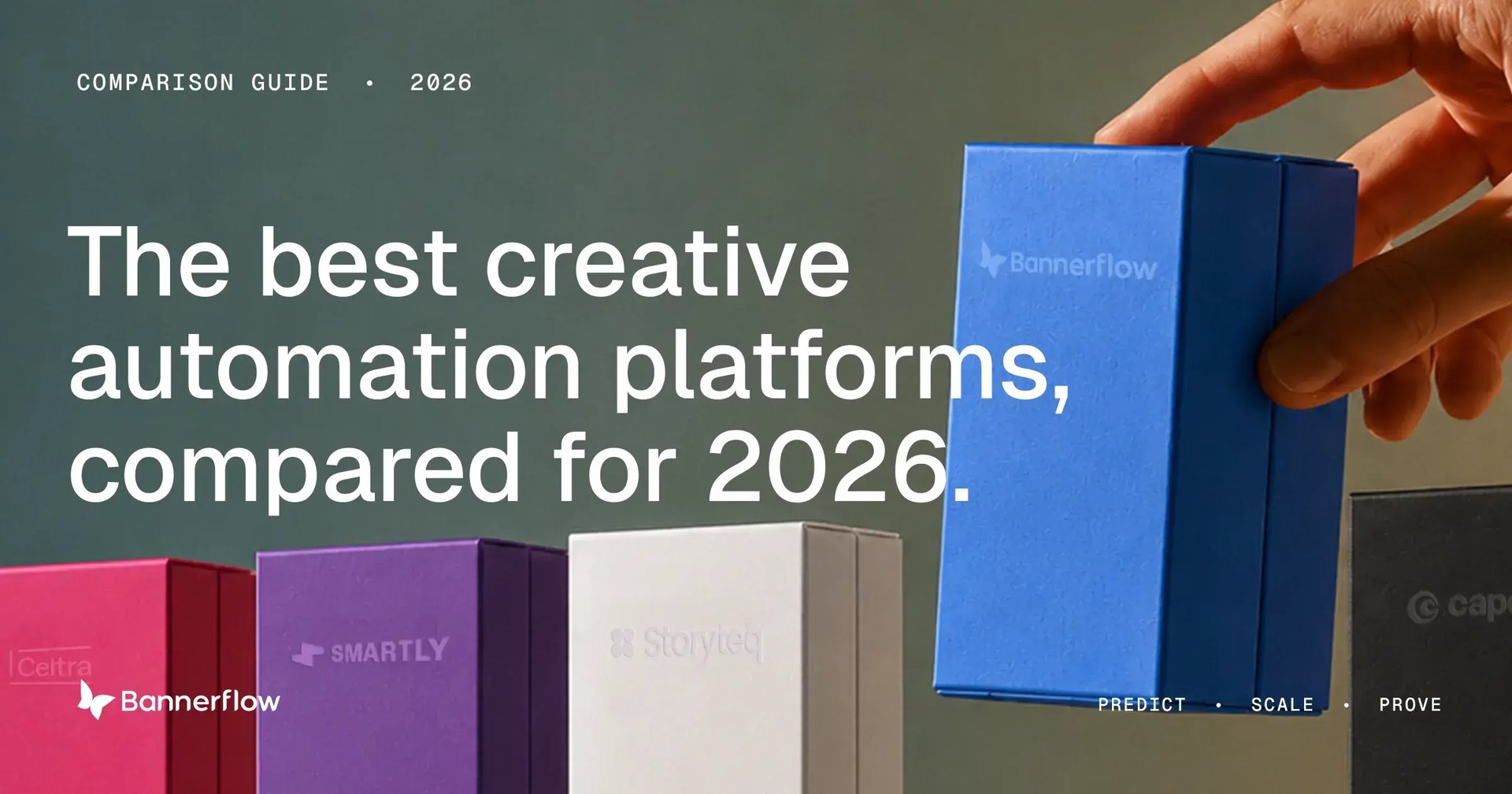
If you're comparing creative automation platforms in 2026, eight names come up again and again: Bannerflow, Celtra, Smartly.io, Storyteq, Brandeploy, Cape.io, The Brief (formerly Creatopy), and Viewst. They are not interchangeable. Celtra and Smartly are built for large enterprise and media-buying scale; Storyteq is a DAM with creative automation layered on top; Brandeploy is a brand portal whose distinct output is print and e-commerce product sheets rather than advertising; Cape.io stretches into broadcast and CTV; The Brief is a smaller self-serve tool, and Viewst is a per-seat HTML5 ad builder for solo designers and small teams. Bannerflow sits in the middle: a creative automation platform built for display and social ad production that connects to 100+ advertising platforms (including The Trade Desk, Amazon DSP, Google DV360, Meta, and TikTok), publishes to DOOH through named partners like JCDecaux and Clear Channel, is a certified Amazon Ads third-party ad server, and scores higher than Celtra and Smartly.io on ease of use in G2's head-to-head comparisons. If you're bringing ad production in-house, it gives you enterprise reach on a platform your team can run without a dedicated ops function.
Creative automation vs creative intelligence
These are not the same thing. Creative automation is about producing and scaling ad variants from one master creative. Creative intelligence adds a layer on top: it predicts which creative will perform before launch, scales that production across markets and formats, and proves impact with attributed results. The difference is a feedback loop, not a one-way production line.
Alternatives to manual display ad production
Four approaches are in common use, and they fail at different points.
1. Resize by hand in a design tool. Photoshop, Figma or Canva will cover a handful of sizes fine. Past that, every size is its own file, so a single price change or legal tweak means reopening all of them, and the file count multiplies again for each market you run in.
2. Hand the work to an agency or production studio. This moves the effort off your team but not the constraint. You pay per version, and you can't make a same-day change to a live campaign when that change has to queue behind someone else's schedule.
3. Use a self-serve ad builder with auto-resize. This fixes the resizing itself, and for a small team it may be all you need. It stops short of publishing. Someone still exports the packages and uploads them platform by platform, and a copy fix after launch means exporting and re-uploading everywhere.
4. Run a creative automation platform wired to a data feed and to your ad channels. This closes that last gap. The master updates, the variants update, and the live ads update with them. The catch is volume and procurement: you need enough campaigns to justify the license, and most platforms at this tier, Bannerflow included, won't sell to you without a sales conversation.
(A note on honesty: this blog is written by Bannerflow, so read this as an informed comparison rather than a neutral one. We've said where competitors win too, and linked to head-to-head pages so you can dig into the specifics that matter to you.)
Why does this comparison exist?
If you've landed here, you're probably feeling one of two pains. Either creative production can't keep up, and every campaign means weeks of agency back-and-forth, or a design bottleneck, multiplied across each format, channel, and market you run in, or you produce plenty of volume, but at a cost and speed that make personalization, testing, and localization impractical. Creative automation platforms exist to fix this. You build a master creative once, then generate, adapt, publish, and optimize every variant from it instead of rebuilding the same ad forty times by hand.
The problem is that these platforms get bundled together on review sites even though they're built for different jobs. Some are creative-production tools with media buying attached. Some are asset-management systems with automation bolted on. Some assume a dedicated operations team; others cost $29 a month and run self-serve. Picking the wrong type, not just the wrong brand, is the most expensive mistake in this category. You usually discover it six months into a contract.
This guide compares the eight platforms most commonly shortlisted in 2026 on the things that actually determine fit:
- What each platform is fundamentally built for: creative production, media buying, asset management, or campaign delivery
- Which ad networks, DSPs, social platforms, and DOOH networks each one can actually publish to
- Who each one fits, by team size, budget tier, and operating model (in-house, hybrid, or agency-led)
- Evidence over marketing claims: published integration lists, G2 reviewer data, certifications, and quantified customer results
How we sourced this: competitor data comes from public G2 reviews, Gartner's Magic Quadrant, and the vendors' own sites, all checked in October 2026. Bannerflow's figures come from our own customer results and the published integration list.
| Platform | Core category | Best fit | Integration reach | DOOH support | Pricing model |
|---|---|---|---|---|---|
| Bannerflow | AI-powered creative automation platform for omnichannel digital advertising | Mid-market to enterprise brands and agencies producing high volume for multiple markets | 100+ platforms incl. The Trade Desk, Amazon DSP, DV360/CM360, Adform, Criteo, Meta, TikTok, LinkedIn | Yes: JCDecaux, Clear Channel, Visual Art, Ocean Media Tech, Sage + Archer | Grow / Pro / Enterprise, based on use case |
| Celtra | Enterprise creative automation / CMP | Large global enterprises, high-volume production | 100+ media channels (per Celtra) | Not published | Enterprise / custom quote |
| Smartly.io | AI-powered advertising (creative + media buying) | Enterprise brands with substantial paid-social budgets | Social / programmatic (Meta, TikTok, Pinterest, Snap, Google) | Not published | Enterprise / custom quote |
| Storyteq | Content Marketing Platform / DAM | Enterprise teams needing DAM + multi-market localization | Not display-network focused | Not published | Custom quote |
| Brandeploy | Brand portal and content automation, connected by API to a DAM or PIM. Print and e-commerce product sheets alongside digital | European enterprises whose output is weighted toward print and product sheets rather than advertising | None published. No named DSP, ad network or social platform integrations | Not published | Not published; free trial available |
| Cape.io | Intelligent campaign automation (omnichannel) | Large enterprises needing broadcast + digital in one system | Broadcast, CTV, DOOH, print, digital | Yes (per Cape.io) | Enterprise / custom quote |
| The Brief | AI ad agency / self-serve creative tool | SMBs and self-serve teams | 40+ ad networks (per The Brief) | Not offered | From $29/mo |
| Viewst | Self-serve HTML5 ad builder. One-click auto-resize reflows the layout instead of cropping it, and a CSV or PIM upload generates a batch of HTML5 variations. No live DCO once the ad is serving. | Solo designers, small in-house teams and agencies that want a predictable per-seat cost | No published DSP or ad-platform integration list. HTML5 packages export for manual upload to Google Ads, Meta, DV360 and similar | Not offered | Published per seat: $110 / $210 / $400 per user per month billed annually, plus custom Enterprise |
Source: vendor sites and G2, checked October 2026. See the full, itemized list on the integrations page.
Why teams choose Bannerflow: the facts you can check
Before the platform-by-platform breakdown, here's the evidence. Every item below is checkable, and we've linked the sources.
- 100+ advertising platform integrations, individually named. That includes every major DSP (The Trade Desk, Amazon DSP, Google DV360/CM360, Adform, StackAdapt, Criteo, RTB House, Xandr), the major social channels (Meta, TikTok, LinkedIn, YouTube), and affiliate networks (Awin, CJ Affiliate, Rakuten, TradeDoubler). Most vendors claim broad reach. Bannerflow publishes the actual list on its integrations page.
- A certified Amazon Ads third-party ad serving partner since November 2025, which means dynamic, shoppable creatives served across Amazon's advertising network.
- DOOH with named media-owner partners: JCDecaux, Clear Channel, Visual Art, Ocean Media Tech, and Sage + Archer. Not a vague "supports DOOH formats" line. Named partners you can ask about on a call.
- Higher ease-of-use scores than Celtra and Smartly.io in G2's head-to-heads. According to G2 reviewer data (October 2026), Bannerflow scores 8.8 on Ease of Use against Celtra's 8.3, and 9.3 on Quality of Support against Celtra's 8.8. Against Smartly, reviewers rated Bannerflow higher on ease of use (8.8 vs 8.3), ease of setup (8.8 vs 8.3), ease of admin (9.0 vs 8.3) and product direction (9.4 vs 8.6). Support is level at 9.3 each, and Smartly is slightly ahead on meeting requirements (8.6 vs 8.5). Overall, Bannerflow holds 4.5 out of 5 on 193 G2 reviews.
- Quantified customer results. One global hospitality group builds campaigns 50% faster across 43 markets in a single workflow. A major games publisher cut campaign production timelines by two-thirds. Both stories are published in full on our customer stories page.
- 2,000+ brands use the platform across iGaming, financial services, travel, retail and entertainment.
Celtra vs Bannerflow
Celtra is the closest peer to Bannerflow on this list. Both are built around display and rich-media creative automation with DCO. Celtra's positioning skews toward the largest global enterprises: it reports 400+ enterprise customers and over 119 billion ad impressions served per year, with named clients including Nike, Spotify, Unilever, and McDonald's.
Where Bannerflow has the edge: usability and support, and this comes from G2's own reviewer data, not from us. Bannerflow scores 8.8 to Celtra's 8.3 on Ease of Use, and 9.3 to 8.8 on Quality of Support. That gap matters more than it looks. Teams bringing creative in-house often don't have a dedicated creative-ops function, so the platform your designers and marketers can run on day one counts as much as feature depth. Bannerflow's 2,000+ brand customer base also spans a wider range of company sizes than Celtra's enterprise-only roster.
Where Celtra may have the edge: feature depth. On G2's Creative Management Platforms feature score, Celtra rates 8.6 to Bannerflow's 8.2. And if you're already operating at enterprise media-buying scale with a dedicated global creative-ops team, Celtra is built for exactly that.
Smartly.io vs Bannerflow
Smartly.io is one of the best-known names in this space, but it does a different job than Bannerflow. Smartly bundles creative production with media buying across social and programmatic channels (Meta, TikTok, Pinterest, Snap, Google) and targets enterprise brands with substantial paid-social budgets. It's as much a media-buying platform as a creative one, and pricing and onboarding reflect that scale.
Where Bannerflow has the edge: on G2's head-to-head comparison, reviewers rated Bannerflow easier to use (8.8 vs 8.3), easier to set up (8.8 vs 8.3), and easier to administer (9.0 vs 8.3). They also rated it higher as a business partner (9.3 vs 9.0) and on product direction (9.4 vs 8.6). Support quality is level at 9.3 for both. The practical difference: if your team needs dedicated display and social creative production rather than a combined media-buying-and-creative system, Bannerflow is built for that specific job, and its display footprint is far broader, with 100+ named platform integrations spanning every major DSP. Smartly's center of gravity is paid social.
Where Smartly may have the edge: if media buying and creative production need to live in one system for your team, Smartly's combined model is not something that Bannerflow tries to replicate. G2 reviewers also score Smartly slightly higher on meeting requirements (8.6 vs 8.5).
Storyteq vs Bannerflow
Storyteq shows up in creative automation comparisons constantly, so let's be precise about what it is. Gartner named Storyteq a Leader in the 2026 Magic Quadrant for Content Marketing Platforms (its fourth consecutive year) and in the 2025 Magic Quadrant for Digital Asset Management, and its architecture reflects that: a Content Portal (DAM) with an Adaptation Studio for creative automation and localization layered on top. Its strongest proof point is multi-market localization at scale. Storyteq's own Heineken case study cites a 40% cost reduction across 160 countries.
Where Bannerflow has the edge: Bannerflow is built for producing, publishing, and optimizing live ad creative, including direct publishing into 100+ ad platforms and real-time dynamic creative optimization. Storyteq's core strength is managing and adapting a brand asset library, which is a different job. If your day-to-day pain is "we need to build, test, and ship more ad variants faster," Bannerflow goes deeper on that exact problem. It handles multi-market work too: one of our hospitality customers runs localized campaigns across 43 markets in a single workflow. A DAM manages your assets; a CMP ships your ads.
Where Storyteq may have the edge: if digital asset management is your primary need rather than creative production, Storyteq's DAM-first architecture is a better starting point than pairing Bannerflow with a separate DAM tool.
Brandeploy vs Bannerflow
Brandeploy is a French brand portal and content automation tool that turns up in creative automation shortlists, though it is built around a different job. Its starting point is brand governance: approved templates, a self-service portal where local teams and partners adapt them, and API connections out to a DAM or PIM. Named customers on its own site include Nuxe, Bayard, Groupe SEB, and Air France, and its footprint is concentrated in France and continental Europe.
Assessing it is harder than it should be, because very little is published. Brandeploy names no DSP, ad network, or social platform integrations. It publishes no DOOH media-owner partners, no pricing, and no customer performance figures, and its G2 profile was created recently with minimal reviewer data behind it. Every platform in this comparison is measured against published, checkable evidence. On that test, Brandeploy is the thinnest entry here.
Where Bannerflow has the edge: on advertising production, the comparison is not close. Channel coverage is not the trade-off Brandeploy's positioning implies: Bannerflow produces display, social, video, rich media, DOOH, and in-store screen creative from one master. The only output types that sit outside that are print and e-commerce product sheets, neither of which is advertising production. Brand governance is not a gap either. Bannerflow runs centrally managed templates, brand rules, role-based permissions, and approval workflows, with local teams adapting messaging and formats inside those guardrails, which is the same distributed-control model on a platform that also publishes the ads. Then comes everything Brandeploy has no published answer for: direct publishing into 100+ named ad platforms, variants that update in flight when the feed changes, dynamic creative optimization on live ads rather than generation at build time, DOOH through five named media owners, and certification as an Amazon Ads third-party ad server. On localization, the proof point is 43 markets in a single workflow for one hospitality customer. Brandeploy's automation stops when the asset is finished; Bannerflow's job starts there.
Where Brandeploy may have the edge: print. If catalogues, in-store print, and e-commerce product sheets are a significant share of your production, Brandeploy covers those and Bannerflow does not. It also offers a free trial without a credit card. Neither is a reason to pick it for advertising production, but if print volume is genuinely large in your operation, it belongs on your list alongside an advertising platform rather than instead of one.
Cape.io (formerly Peach) vs Bannerflow
Cape.io is the broadest-scope platform here. It spans display, social, video, DOOH, print, email, and broadcast/CTV, and it's aimed at large enterprises; its published case studies include KLM (campaigns across 67 markets) and Ubisoft. If your creative operation covers broadcast TV alongside digital, it's built for that wider remit.
Where Bannerflow has the edge: depth over breadth in the channels most digital marketing teams actually run. Bannerflow's 100+ integrations are individually named and published, covering every major DSP, the social platforms, affiliate networks, and five named DOOH media owners, and it's a certified Amazon Ads third-party ad serving partner. Its vertical track record is deep and checkable too: customers with quantified results across iGaming, financial services, travel, retail and entertainment. If your world is digital display, social, and DOOH rather than broadcast spots, Bannerflow covers everything you use with more specialized tooling for it.
Where Cape.io may have the edge: if your creative operation spans broadcast and linear TV alongside digital, if you are running campaigns that include these channels , Cape.io's unified system is more relevant for you.
The Brief (formerly Creatopy) vs Bannerflow
The Brief rebranded from Creatopy in October 2025 and shifted from a banner-design tool toward a full-stack "AI ad agency" model (Discover → Create → Launch → Optimize). It's priced for self-serve and SMB use, with plans from $29/mo. That's a fundamentally different market than Bannerflow's mid-market-to-enterprise focus.
Where Bannerflow has the edge: scale and depth. Bannerflow supports over 100 named ad platform integrations to the roughly 40+ The Brief cites for itself, publishes to DOOH through named media-owner partners where The Brief has none, and offers DCO, ad localization, and campaign publishing built for enterprise volume. A $29/mo self-serve tool and an enterprise CMP are solving different problems, and it helps to be honest about which problem you have.
Where The Brief may have the edge: price transparency and self-serve access. It publishes real pricing, and you can start without a sales conversation, which Bannerflow doesn't currently offer. If budget and immediate access matter more than enterprise-scale depth, that's a genuine consideration.
Viewst vs Bannerflow
Viewst is a self-serve HTML5 ad builder aimed at solo designers, small in-house teams, and agencies. Its core pitch is resizing: one-click auto-resize reflows text and repositions elements across aspect ratios instead of cropping, so one master layout becomes the full IAB size set. Upload a CSV or a PIM export and it generates a batch of HTML5 variations, one per row. Pricing is published per seat at $110, $210, and $400 per user per month billed annually, with a custom Enterprise tier and a 14-day trial.
Where Bannerflow has the edge: what happens after the ad is built. Viewst produces HTML5 packages that someone then uploads to each ad platform by hand, and its CSV generation is a batch job at build time, not dynamic creative optimization on a live ad. Bannerflow publishes directly into 100+ named ad platforms, updates variants in flight when the feed changes, and reaches DOOH through five named media owners. If a price moves or a promotion ends mid-flight, Bannerflow updates the running ads; a build-and-export tool means rebuilding and re-uploading everywhere.
Where Viewst may have the edge: published pricing and a low floor. You can see the cost before you talk to anyone, start on a single seat, and export unlimited HTML5 without per-export charges. For a designer producing display ads for a handful of campaigns, that is a reasonable place to start, and Bannerflow isn't priced or built for it.
Innovid: why it's not really in this category
Innovid gets listed alongside these platforms because of its 2025 merger with Flashtalking, a legacy display ad server. But its core identity is CTV/video ad-serving. Its former NYSE ticker was literally "CTV." Market-share data from 6sense puts Innovid at a fraction of one percent of the Ad Creative Management category, a strong signal that display and social ad creative isn't where it competes day-to-day. If your evaluation is about display/social creative automation, Innovid is solving a different, video-first problem. Worth knowing: Bannerflow integrates with Flashtalking by Innovid as an ad server, so the two can work together rather than compete.
Which is the best creative automation platform for your team?
There's no single winner across every use case. That's true of Bannerflow too, and we'd rather say so than force a false conclusion.
Where Bannerflow is not the right call: if you want pricing you can see without talking to sales, native broadcast or CTV production, or a standalone digital asset manager, other tools on this list do that specific job better.
- Choose Bannerflow if you're bringing omnichannel ad creative production in-house. You get the broadest published integration reach in this set (100+ platforms, named DOOH partners, Amazon Ads certification) on a platform G2 reviewers rate above Celtra and Smartly.io on ease of use in head-to-head comparisons, without Celtra or Cape.io scale enterprise complexity.
- Choose Celtra or Cape.io if you're already operating at global enterprise scale with dedicated creative-ops teams. Cape.io, especially if broadcast TV is in scope.
- Choose Smartly.io if creative and media buying need to live in one system.
- Choose Storyteq if DAM and multi-market asset management is your primary need, with creative automation second.
- Choose Brandeploy only if print catalogues and e-commerce product sheets are a large share of your output, and expect to pair it with an advertising platform for the digital side.
- Choose The Brief if you're a smaller team wanting a newer, self-serve-friendly, lower-cost option.
- Choose Viewst if resizing is the whole problem, you want published per-seat pricing, and you're happy to upload the finished packages to each ad platform yourself.
- Innovid isn't a fit unless your primary need is CTV/video ad serving.
Want to see what creative automation would actually save your team? Bannerflow's efficiency calculator models time and cost savings from your own campaign volume, team size, and market count.
If you are struggling to keep up with the creative demand required to reach your business goals, and not quite sure how to approach making a business case for a creative automation tool, you can also download our guide to implementing creative automation, which provides a practical playbook designed for marketing and creative leaders ready to transform production and unlock smarter, faster campaign delivery.
FAQs
What are the alternatives to manual display ad production?
Four: resizing by hand in a design tool, outsourcing to an agency or production studio, a self-serve ad builder with auto-resize, or a creative automation platform connected to a data feed and your ad channels. The first three hold up at low volume. They break either when the volume climbs or when the ad has to change after it's gone live.
What's the difference between Bannerflow and Brandeploy?
Brandeploy is a brand portal: approved templates, a self-service portal for local teams and partners, and API links to a DAM or PIM. Its distinct output is print and e-commerce product sheets. Bannerflow produces display, social, video, rich media, DOOH, and in-store screen creative, with the same centrally managed templates, brand rules, permissions, and approval workflows, and then publishes into 100+ named ad platforms, runs DCO on live ads, and reaches DOOH through named media owners. Brandeploy publishes no integration list, no DOOH partners, and no pricing. If the job is advertising production, Bannerflow is the deeper platform by a wide margin.
Is Viewst a good alternative to Bannerflow for display ad production?
For a solo designer or a small team, it can be. Viewst publishes seat pricing from $110 per user per month billed annually, auto-resizes layouts in one click, and generates HTML5 variations from a CSV or PIM export. It doesn't publish into ad platforms for you or run DCO on live ads, so someone still uploads the packages by hand, and a change after launch means doing that again on every platform.
What's the difference between Bannerflow and Celtra?
Both are creative automation platforms for display and rich-media advertising. Celtra is positioned for the largest global enterprises running high-volume creative production. Bannerflow serves a broader range of company sizes and scores higher with G2 reviewers on ease of use (8.8 vs. 8.3) and quality of support (9.3 vs. 8.8), while Celtra scores higher on G2's Creative Management Platforms feature rating (8.6 vs. 8.2).
Is Storyteq a creative automation platform or a DAM?
Both, but its center of gravity is digital asset management. Gartner recognizes it as a Content Marketing Platform/DAM leader. Bannerflow, by contrast, is built for producing and publishing live ad creative directly into 100+ ad platforms.
Which creative automation platform has the best ad-network coverage?
Bannerflow publishes a named list of 100+ advertising platform integrations, including The Trade Desk, Amazon DSP, Google DV360, Meta, and TikTok, plus five named DOOH media-owner partners. That's the broadest published, itemized integration list in this comparison set.
Do any of these platforms publish transparent pricing?
Two do. The Brief publishes self-serve pricing starting at $29/month, and Viewst publishes per-seat pricing at $110, $210 and $400 per user per month billed annually. Bannerflow, Celtra, Smartly.io, Storyteq, Brandeploy, and Cape.io do not currently publish pricing publicly, so expect a sales conversation for a specific quote from most of this category.
Is Innovid a real alternative to Bannerflow?
Not really. Innovid is primarily a CTV/video ad-serving platform, not a display/social creative automation tool. Bannerflow actually integrates with Flashtalking by Innovid as an ad server, so the two can complement rather than compete.
Which platform is best for a mid-market team bringing creative in-house for the first time?
Bannerflow and The Brief are the two most accessible to a team without existing enterprise-scale creative-ops infrastructure. Bannerflow offers the deepest feature set and longest track record of the two at that tier, and G2 reviewers rate it easier to set up and administer than Celtra and Smartly.io.