

Last updated
Marketing teams don't have a creativity problem. The real problem they face is in their ability to juggle the variety of tasks required to showcase that creativity. In Adobe's 2025 global marketing study, 58% of marketers pointed to the same drain: admin, reviews, and approvals. That overhead eats 41% of content-creation time, about 25 minutes of every hour. The ideas aren't the constraint; everything around the ideas is.
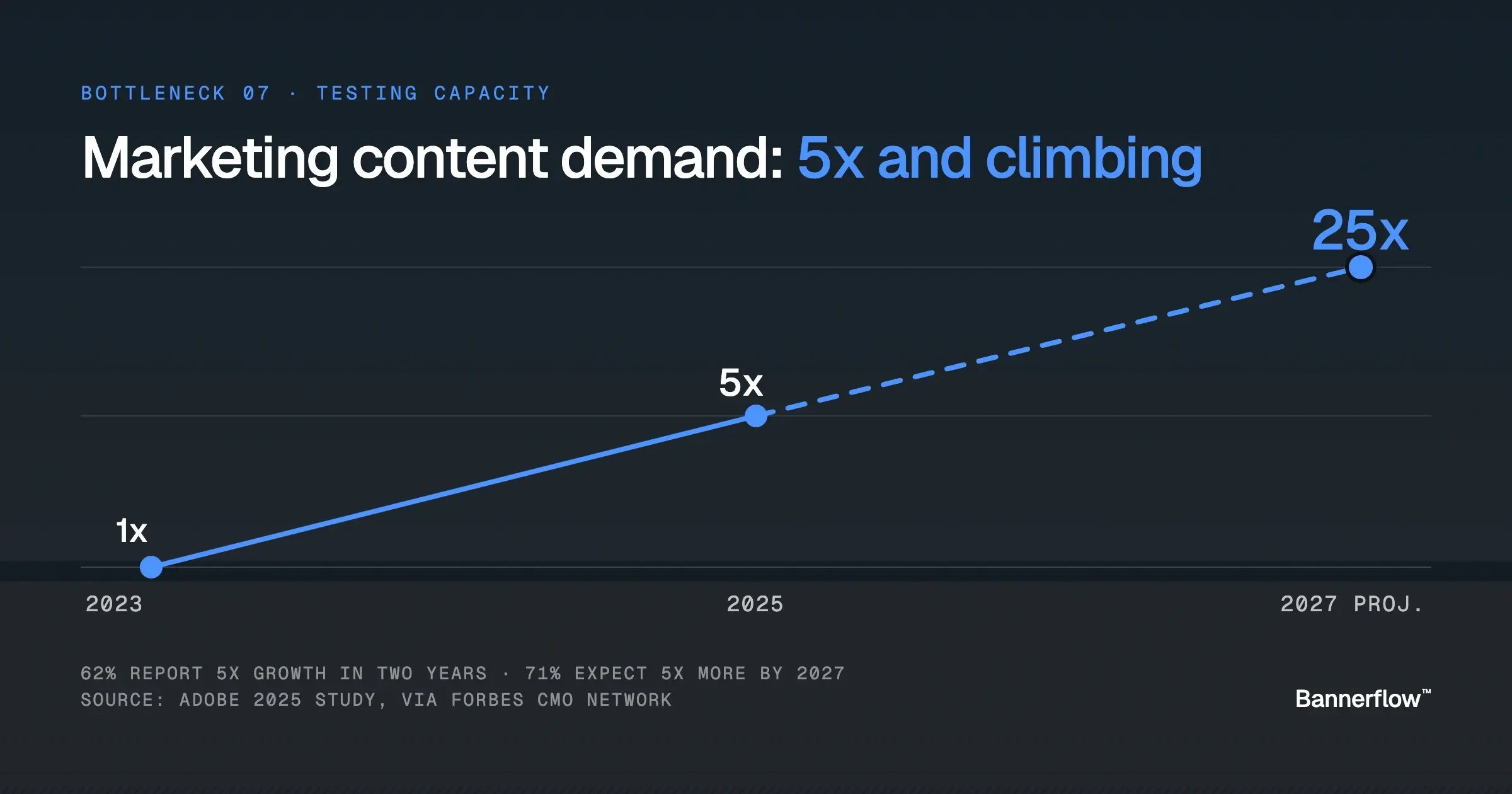
And the pressure continues to rise: 62% of marketers say content demand has risen at least fivefold in two years. Another 71% expect it to grow fivefold again by 2027. Yet only 30% of brands, agencies, and publishers have fully integrated AI across the campaign lifecycle. The demand curve and the capacity curve are pulling apart.
Creative automation is how teams close that gap. It handles the mechanical half of production so people can spend their hours on the half that actually needs them. This is where creative meets automation to unlock scale, speed, and control.
Below are the seven creative workflow bottlenecks that automation solves, what each one costs you, and how brands like SEGA, Scoot, CMC Markets, Coop, Boozt, Telia, and Kaizen fixed them.
Learn more about how creative automation works and why teams are adopting it →
Key Takeaways
- Marketers lose 41% of content-creation time to admin, reviews, and approvals, and nearly 90% face three or more approval stages before publishing (Adobe)
- Content demand has grown 5x in two years and is set to grow 5x again by 2027, while only 30% of teams have fully integrated AI (Adobe; IAB)
- 76% of shoppers prefer to buy in their own language, and 40% won't buy in another, making localization a revenue issue, not a nice-to-have (CSA Research)
- Consistent brand presentation across channels is tied to up to a 33% revenue increase (Lucidpress/Marq)
- Real results: SEGA cut production two-thirds, Boozt made 27,766 creatives with one designer, CMC Markets lifted post-click conversions 23%, and Hallon and Kaizen doubled output (Bannerflow customer stories)
The 7 Creative Workflow Bottlenecks at a Glance
Here are the seven bottlenecks, what each one costs, and how creative automation solves it.
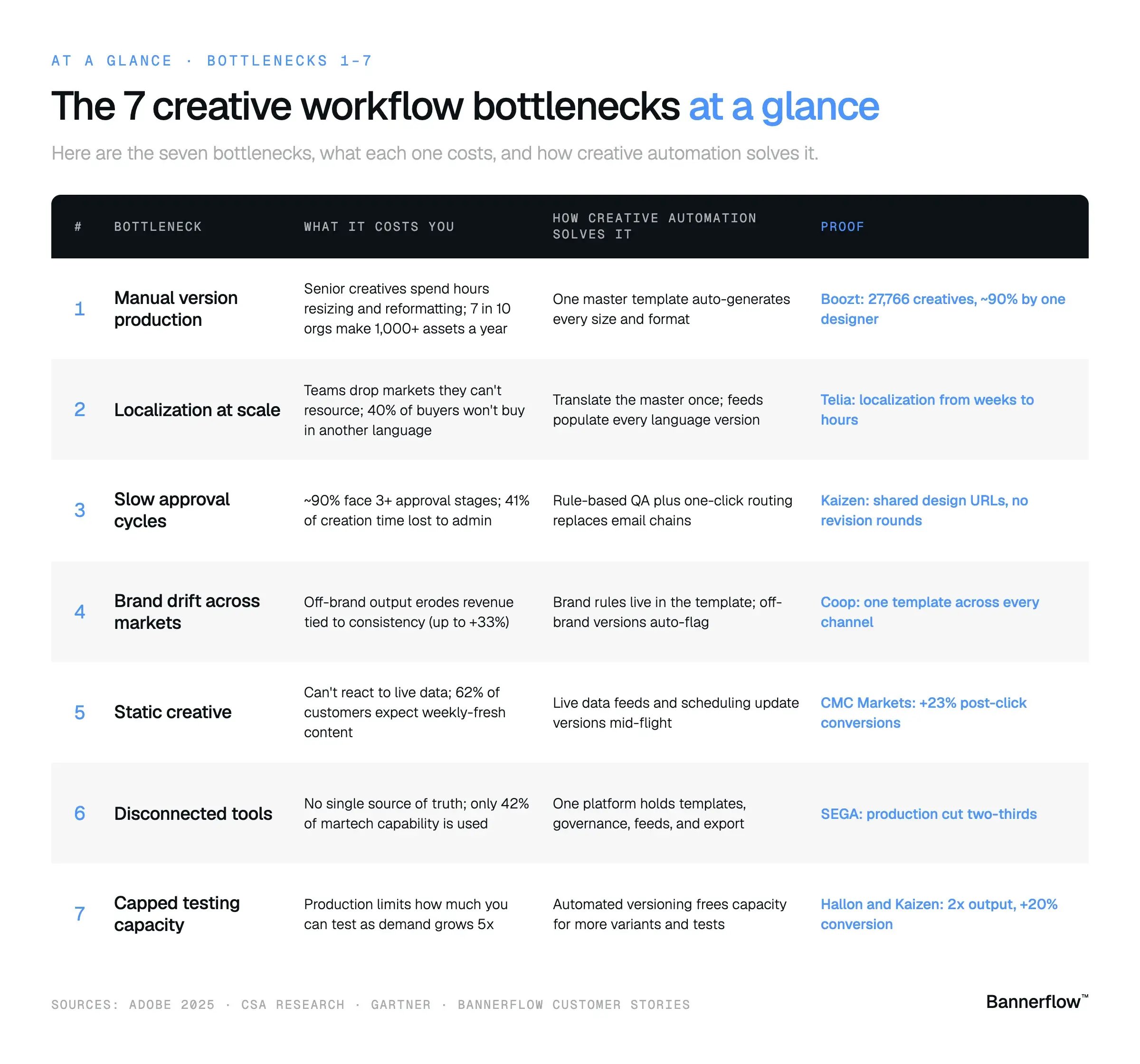
Bottleneck 1: Manual Version Production Buries Your Best People
A single cross-channel campaign now spans dozens of sizes, formats, and specs, and someone builds each one by hand. Seven in ten marketers say their organization creates more than 1,000 assets a year, and roughly a quarter produce between 10,000 and 100,000. Most of that work is mechanical.
This is where a lot of organizations are failing: the people resizing banners for 30 placements and reformatting video for four aspect ratios are usually your most senior creatives. The task needs their hours, not their judgment. That's a lot of time spent on work that isn't very rewarding and doesn't show off your level of experience or skill.
Creative automation breaks this pattern through a master template. A designer builds one campaign creative with brand rules, typography, and layout logic directly built in. The system generates every required version from that single source: every IAB display size, every social format, every video ratio. The designer works once. The tool does the adaptation.
Boozt, the Nordic fashion retailer, shows the ceiling this removes. The team produced 27,766 creatives in 2025, with roughly 90% handled by a single campaign designer. "Before, there was a lot of manual work, from copy-pasting to duplicating creatives," says Miltos Iakovidis, Campaign Designer at Boozt. This is the benefit of being able to focus on design without spending time on time-consuming tasks that have no real impact on the quality of the output. Even with a lean team, you can produce enterprise volume.
Seven in ten marketing organizations create more than 1,000 assets a year, and about 25% produce 10,000 to 100,000. Creative automation generates every version from one master template. Boozt produced 27,766 creatives in 2025, with roughly 90% handled by a single designer.
Bottleneck 2: Localization That Forces You to Pick Your Markets
Localization is a revenue issue, not a nice-to-have: 76% of online shoppers prefer to buy in their own language, and 40% will not buy from websites in other languages. Skip a market's language, and you lose up to 40% of the buyers in that market.
Yet localization is where most teams hit their hardest ceiling. Adapting a campaign for ten language markets the manual way means ten separate rounds of designer time, so teams quietly drop the markets they can't resource. That's a revenue decision disguised as a production one.
Creative automation flips the economics. You translate master copy once, connect language and market feeds, and the system populates every localized version automatically. A campaign across 20 markets stops being 20 manual adaptations and becomes one workflow.
Telia, the Nordic and Baltic telecoms group, cut localized ad production from weeks to hours using this model. Scoot, the Singapore Airlines low-cost carrier, reduced campaign launch times from days to hours across APAC markets and produced more than 500 HTML5 banners through the platform. Kaizen Gaming runs around 100 campaigns and holds consistent branding across 14 markets. None of them had to choose which markets to serve.
76% of consumers prefer to buy in their own language, and 40% won't buy in another. Creative automation localizes from one master, so serving every market costs one workflow, not one per market. Telia cut localized production from weeks to hours.
Bottleneck 3: Approval Cycles That Live in Email Chains
The approval loop is the quietest killer of campaign timelines. Nearly 90% of marketers have at least three approval stages before an asset can publish. Almost half say each piece of content passes through 51 to 200 people to create, review, approve, and activate. It’s no wonder 41% of creation time disappears into admin.
When assets move for sign-off through email, a single round of revisions can add days of delay. Nobody can see where a file is stuck. Nobody knows they're the blocker. That's exactly the wrong condition for fast production, and it's a marketing operations problem more than a creative one.
The way to fix this is to move governance and review into the system itself. Rule-based quality checks run before any asset reaches a human, so off-spec versions get flagged automatically, and only clean assets make their way to approvers, with one-click sign-off instead of inbox archaeology. Fewer revision cycles, and revision cycles are where most production time vanishes.
Kaizen replaced back-and-forth review with shared design URLs rather than manual revisions. SEGA went further, freeing its agency partners from setup entirely. "Instead of them spending a significant amount of time on campaign set-up, we can ask them to focus on more important business challenges, like overall media strategy, optimization, innovation and performance," says Matt Whittles, Senior Media Planning Manager at SEGA.
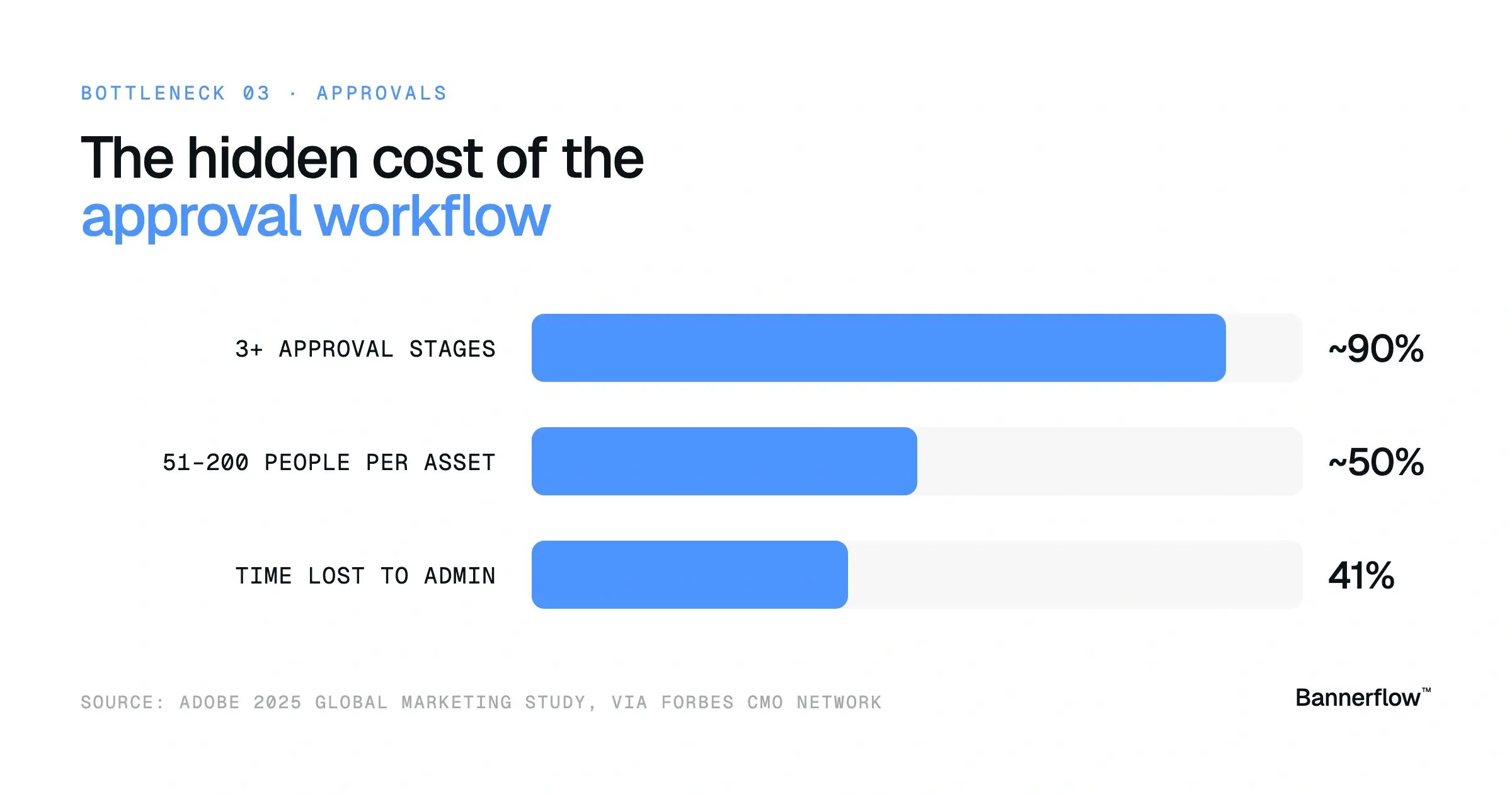
Nearly 90% of marketers face three or more approval stages, and roughly half route each asset through 51 to 200 people. Automated, rule-based QA and one-click routing cut that overhead. Kaizen replaced revision rounds with shared design URLs.
Bottleneck 4: Brand Consistency Breaks Across Markets and Versions
The more variations you produce and the more markets you serve, the harder brand consistency gets, and the more it costs when it falls through the cracks. Consistent brand presentation across all channels can generate up to a 33% increase in revenue. Every off-brand banner is a small tax on that number.
Manual production makes brand drift almost inevitable. When a logo, a color value, or a font is applied by hand across hundreds of files and a dozen markets, mistakes slip through, and catching them adds yet another review layer.
Automation makes consistency the default instead of the goal. Brand rules live inside the platform: fonts, color values, logo placement, and spacing constraints are locked in, and every generated version inherits them. If a version falls outside those parameters, the system flags it before a human ever sees it. This is the control half of scale, speed, and control.
Coop Denmark, one of the country's largest grocery retailers, runs this way. "When we create a template, it's easy to produce it across different channels. We don't have to produce it for each channel separately," says Klaes Simonsen, Senior Digital Strategist at Coop. Kaizen holds the same consistency across 14 markets and multiple platforms at once. Governance stops being a bottleneck and becomes a property of the system.
Consistent brand presentation across channels is linked to up to a 33% revenue increase. Creative automation locks brand rules into the master template and flags off-brand versions automatically, holding consistency across every market, as Coop and Kaizen do across their channels and 14 markets (Bannerflow).
Bottleneck 5: Static Creative You Can't Once Live
Audiences expect fresh, relevant creative, and static campaigns can't keep up. 62% of marketers say customers now expect new content at least weekly, and more than 60% report expectations for personalized interactions (Adobe, via Forbes, 2025). When your creative is baked into static files, reacting to a price change, a result, or a trending moment means rebuilding from scratch, and the moment is usually gone by the time you ship.
Live data feeds fix this. Connect them to the template and content updates itself: product catalogs, current pricing, localized messaging, and market-specific legal copy populate every version automatically. Scheduling tools let teams plan mid-campaign swaps without touching a single file by hand. Test faster, scale smarter.
CMC Markets used this to act on performance data fast enough to move numbers. "Topical messaging is improving conversion rates, and now that we're able to do this more often, we're seeing increases in post-click conversions of around 23%," says Allan Sheriff, Head of Display at CMC Markets. Coop swaps creative on a Monday-to-Tuesday turnaround: "Monday we can have one creative that changes Tuesday. We can schedule these quick changes in Bannerflow," says Simonsen.
This is also the point of the wider shift from automating production to building intelligence around creative. Data doesn't replace creativity; it enhances it: live signals tell you which version is working so the next one is better.
62% of marketers say customers now expect new content at least weekly, and more than 60% expect personalized interactions. Static creative can't meet that pace. Live data feeds and scheduling let teams update mid-flight: CMC Markets lifted post-click conversions around 23% from topical messaging (Bannerflow).
Read Bannerflow's complete guide to dynamic creative optimization
Bottleneck 6: Disconnected Tools Break Marketing Operations
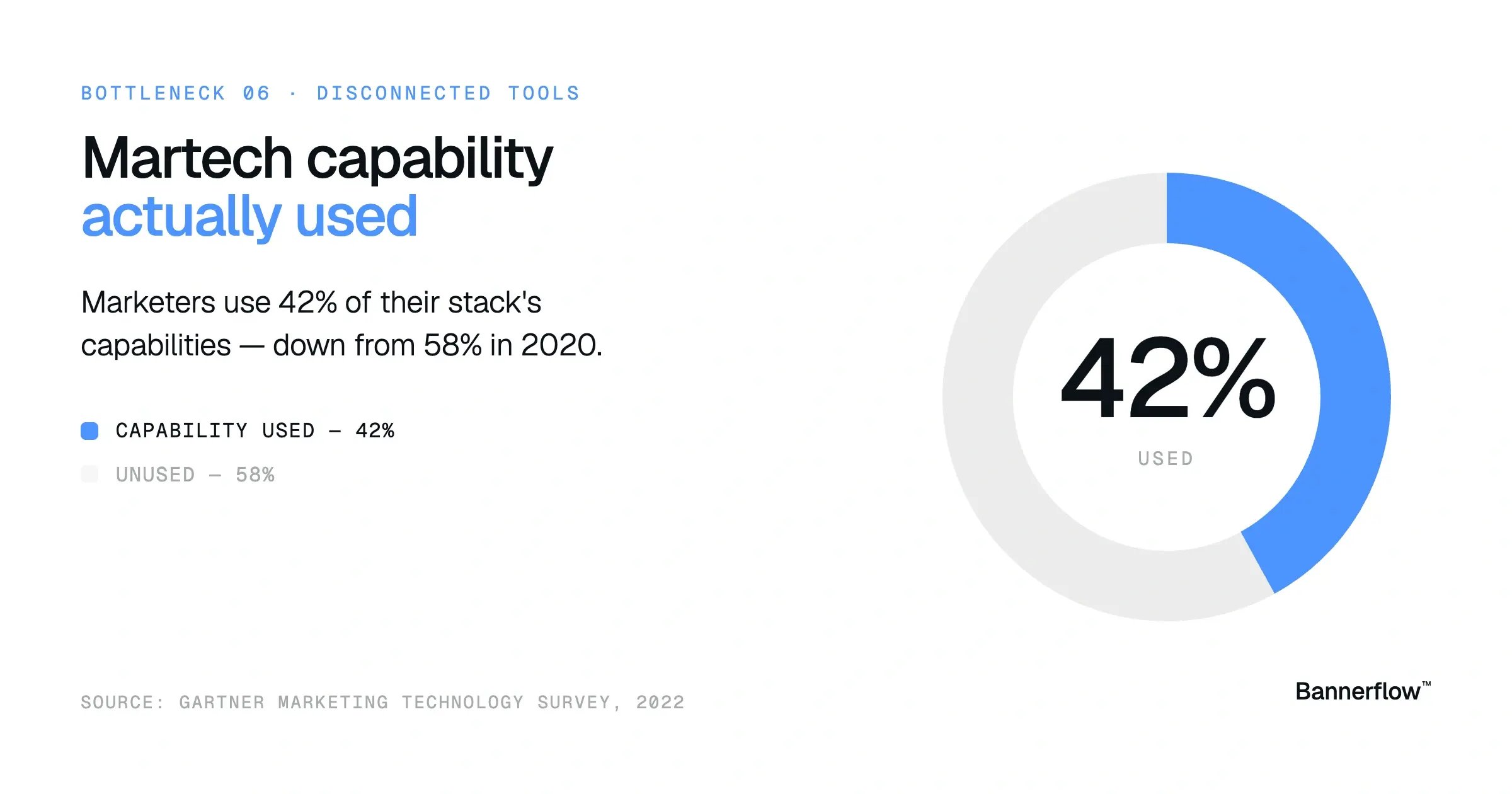
Fragmented tooling is a marketing operations bottleneck hiding in plain sight. Marketers use just 42% of their martech stack's capabilities, down from 58% in 2020, and each content piece can pass through 51 to 200 people. When assets, feedback, and brand rules live in separate tools, every handoff is a chance to lose a version, use the wrong logo, or ship stale copy.
A single platform is the solution. Bring templates, brand governance, feeds, review, and export into one place, and the handoffs disappear. Instead of chasing the latest file across five tools, everyone works from the same live version, one source of truth for the whole team.
SEGA redirected its agency relationship around exactly this, cutting campaign production by two-thirds and spending less time on setup and more on media strategy and performance. Kaizen runs roughly 100 campaigns from a single platform. Consolidation is what turns creative operations into a growth engine rather than a coordination tax.
Marketers use just 42% of their martech stack's capabilities (Gartner, 2022), and each content piece can pass through 51 to 200 people. Consolidating production into one platform removes the handoffs: SEGA cut production by two-thirds after doing exactly that.
Bottleneck 7: Production Caps How Much You Can Test
The last bottleneck is the most strategic. When production is slow, teams ship one or two concepts per campaign because that's all they can build, not all they want to test. Meanwhile, content demand, as we previously highlighted, is expected to be fivefold its current level by 2027. Production capacity, not ideas, is what limits how many insights you can generate from your creative output.
That gap is already felt: 48% of marketers say they struggle to keep pace with rising content demand. Content scalability is the difference between testing more and settling for less.
Creative automation lifts the cap. When versioning, localization, and QA are automated, the same team can produce far more, which means more variants, more A/B tests, and more chances to find what works. The output gains are measurable.
Hallon doubled its creative output and lifted conversion rates by 20%, optimizing in real time without developer or CMS blocks. Kaizen also doubled output while driving a 20% increase in conversions and a 15% lift in user engagement. More production capacity didn't dilute the creative. It made room for better creative to surface.
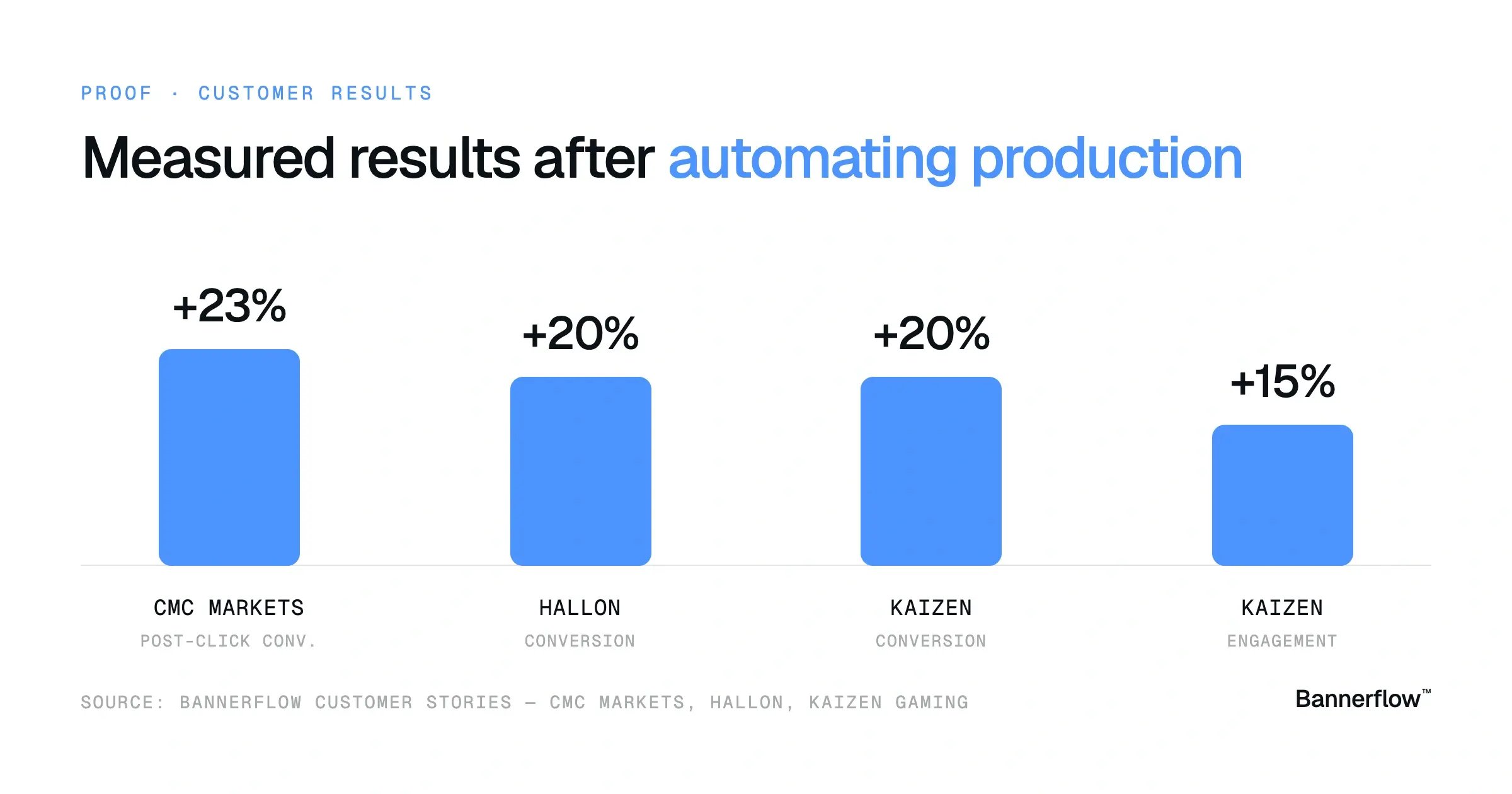
Content demand rose fivefold in two years, with 71% of marketers expecting another fivefold increase by 2027, and 48% of marketers say they struggle to keep pace. Automating production lifts the cap: Hallon and Kaizen each doubled output, with conversion up 20% (Bannerflow).
The Pattern Behind All Seven
Look across the seven and the same root cause shows up every time: mechanical work sitting between a team and its ideas. Resizing. Reformatting. Localizing. Routing for approval. Rebuilding to update. Chasing files across tools. None of it needs creative judgment, and all of it eats the hours that do.
That's the real case for creative automation. It's a performance case, not just a cost one. The most creative and effective ads earn several times the profit of average ones. But you only get there by testing more and moving faster than manual production allows. Automate the mechanical layer, and you get scale, speed, and control in one move: more on-brand output, faster cycles, and consistency across every market.
The Bottom Line
Every one of these seven bottlenecks comes down to the same thing: talented people doing mechanical work. Creative automation doesn't replace the creativity. It clears the machinery around it, so your team spends its hours on strategy, iteration, and the ideas that actually move numbers. Across the teams I've worked with, the ones who win aren't the ones with the biggest budgets. They're the ones who stopped spending senior talent on file resizing.
The proof is consistent across verticals. SEGA cut production two-thirds. Boozt made 27,766 creatives with essentially one designer. Telia went from weeks to hours on localization. CMC Markets lifted post-click conversions 23%. Hallon and Kaizen doubled output. In every case, automating the mechanical layer freed the team to do better work, not less of it.
Content demand is heading for another fivefold jump by 2027. You can meet it by hiring against an impossible curve, or by clearing the bottlenecks that make the curve impossible in the first place. Data doesn't replace creativity; it enhances it, and automation is what gives your team the room to prove it.
The complete guide to creative automation →
Ready to clear your creative bottlenecks?
See how Bannerflow's creative automation platform helps enterprise and agency teams produce more on-brand campaigns, in more markets, in less time.
FAQs
What Are the Biggest Creative Workflow Bottlenecks?
The most common are manual version production, localization across markets, slow approval cycles, brand governance drift, static creative that can't update mid-campaign, disconnected tools with no single source of truth, and limited testing capacity. Approvals are the quiet killer: nearly 90% of marketers face three or more approval stages before publishing (Adobe, 2025).
How Does Creative Automation Improve Brand Consistency?
It locks brand rules into a master template, so fonts, colors, logo placement, and spacing are built in and every generated version inherits them. Off-brand assets get flagged before a human reviews them. Consistent brand presentation across channels is tied to up to a 33% revenue increase (Lucidpress/Marq, 2019).
Does Creative Automation Replace Designers or Reduce Creative Quality?
No. It removes the mechanical work (resizing, reformatting, and localizing) that consumes most of a team's hours, and hands that time back to creative thinking. Teams that automate tend to test and iterate more. Boozt produced 27,766 creatives in 2025 with roughly 90% handled by one campaign designer (Bannerflow).
Where Should a Team Start With Creative Automation?
Start with your highest-volume, most repetitive format, usually display banners, and automate that first. Build one master template with brand rules baked in, measure the time saved on your own campaigns, then expand to social, video, and localization. The payback usually lands within the first campaign cycle.