Personalization is becoming one of the biggest performance unlocks in display advertising in 2026. In this guide, you’ll learn what personalized display really means, why it drives stronger engagement and ROI, and how data, dynamic creative optimization (DCO), and scalable production workflows work together to deliver relevant ads at scale.
Guide
The ultimate guide to personalization in display advertising
/BannerFlow_March2023/images/the-ultimate-guide-to-personalisation-in-display-advertising-v2_880x664.jpg?width=880&height=664&name=the-ultimate-guide-to-personalisation-in-display-advertising-v2_880x664.jpg)
Quick Links
- Introducing Personalization in Display Advertising
- What Are the Advantages of Personalization in Display Advertising?
- What Is Personalization in Display Advertising?
- The Personalization Journey in Display Advertising
- Why Personalization Matters, What the Data Says
- How Can You Do One-to-One Personalization in Display Advertising?
- Do You Need a Data Management Platform (DMP)?
- How Does Targeting Work in an Ad Server vs. a DSP?
- What Are the Benefits of Using a Creative Automation Platform for One-to-One Personalization?
- What Is Onsite Personalization / Onsite DCO?
- What Does the Future of Cookies Mean for Personalization?
- Conclusion
Introducing Personalization in Display Advertising
Personalization is often described as the “Holy Grail” of display advertising, and for good reason. It means delivering the right message to the right person at the right time, with the most relevant creative. When executed properly, personalization transforms generic ads into compelling, individualized experiences.
Why You Should Personalize Your Display Campaigns
A Short History of Personalization
Personalization isn’t a new idea. Long before digital ads, retail owners tailored their offers based on what they knew about their customers. Over time, especially with the rise of large retailers and chains, marketing became less personal. And when online advertising emerged, many ads treated users as faceless targets rather than individuals.
But today, everything has changed. Thanks to advances in data, automation, and ad technology, true personalization is not only possible, but it's also increasingly expected.
According to a 2025 global survey by Boston Consulting Group (BCG) of over 23,000 consumers, a substantial majority say they expect companies to deliver personalized experiences, and many view personalization as a normal part of brand interaction.
In parallel, 74% of digital marketing leaders report increasing their investment in personalization, signaling that personalization is becoming a strategic priority rather than a nice-to-have.
Still, while many brands believe in personalization, fewer have fully embedded it into their operations. This gap between intent and execution is where a robust creative automation platform can make a difference.
What Are the Advantages of Personalization in Display Advertising?
1. More Engaging, Relevant Content
Generic, one-size-fits-all ads struggle in today’s landscape of ad fatigue, banner blindness, and ad blockers. Personalized ads break through by delivering messaging that resonates with each user’s interests, context, or past behavior.
Customers appreciate this: a 2025 report found that 76% of consumers expect personalized experiences from brands, and many say they become more loyal when brands deliver them. When done right, personalization keeps your brand relevant and makes each impression meaningful, not just noise.
2. Ads That Stand Out
When ads are tailored to each user segment, showing relevant products, offers, or content, they naturally stand out more. This individualized approach contrasts sharply with generic ads that blend into the background.
With rising ad saturation, personalization helps your creative cut through the clutter and capture attention. For many consumers, that relevance determines whether they engage or ignore the ad entirely.
3. Meeting Consumer Expectations
Modern audiences expect personalization. According to one 2025 industry analysis, 89% of marketing decision-makers consider personalization essential for business success over the next few years. Consumers are increasingly willing to engage with brands that understand them and deliver relevant experiences. When brands fail to personalize, they risk being perceived as tone-deaf or out of touch, which can erode trust and loyalty.
4. Better Performance & ROI
Personalization isn’t just about feel-good experiences; it delivers measurable results. Studies show that companies that implement advanced personalization strategies report stronger performance across key metrics. More relevant ads result in higher engagement, better conversion rates, and often improved retention. When you combine personalization with dynamic creative and data-driven workflows, you unlock a powerful engine for performance and growth.
What to Keep in Mind When Personalizing Display Ads
While personalization offers strong benefits, execution matters. According to a recent report from Deloitte Digital, many brands overestimate how personalized their interactions are: only about 43% of consumers felt their recent brand experiences were genuinely personalized, even though brands estimated the number at 61%. This “perception gap” shows the importance of delivering personalization thoughtfully, respecting privacy, and ensuring relevance. Poorly executed personalization, especially if it feels invasive or off-target, can backfire. Thus, personalization should always balance relevance with respect, combining data-driven insights with creative sensitivity.
What Is Personalization in Display Advertising?
Personalization in display advertising means combining user data and relevant content to create ad experiences tailored to individual viewers. It’s all about delivering the right message to the right person at the right time using the most relevant and creative ad formats.
True one-to-one personalization turns generic ads into bespoke experiences. But for many brands, getting there is a journey, one that involves mastering different levels of display campaigns, from basic to dynamic, to fully data-driven personalization.
The Personalization Journey in Display Advertising
Here’s a simplified progression many marketers follow on the way to true personalization:
- Non-dynamic display advertising — standard display ads scaled out to multiple sizes and variations, with no updates or personalization after launch.
- Dynamic display advertising — manually optimized ads; for example, campaigns that use regularly updated data feeds (like product availability) or manual A/B testing.
- Automatically optimized campaigns — using technology (algorithms/automation) to choose the top-performing creatives automatically based on performance data.
- Audience personalization — ads are tailored to specific audience segments (e.g. demographic, interests) using available data.
- One-to-one personalization — ads tailored to individual users, based on first-party data and real-time signals, the most advanced level of personalization.
What You Need Internally to Deliver Personalization
Before launching personalized display campaigns, your marketing organization typically needs three foundational capabilities:
- Data segmentation: You must know your audience, who they are, what they search for, and their behaviors. This allows you to tailor ad copy, creative, and messaging based on real insights.
- Real-time updating capability: Your platform must support live updates, so you can change creatives, messages, or offers on the fly, ideally without republishing everything manually.
- Scalable ad production: For segment-based or individual personalization, you often need hundreds (or thousands) of ad variations. Without scalable creative infrastructure, manual production becomes unwieldy and inefficient.
If any of these are missing, data, technology, or scalability, true personalization becomes very difficult or impossible.
Why Personalization Matters, What the Data Says
Personalization is no longer optional; it’s increasingly expected by consumers and widely recognized by marketers as a major driver of performance:
- 71% of consumers now expect companies to deliver personalized interactions.
- 89% of marketing decision-makers say personalization will be critical to their business’s success in the next few years.
- 74% of digital marketing leaders are increasing investment in personalization in 2025.
When done right, personalization can boost customer engagement, drive conversions, and improve return on investment while delivering better user experiences. That shift, from generic mass-marketing to targeted, relevant communication, is increasingly what separates high-performing brands from the rest.
What’s Holding Brands Back and Why Many Don’t Personalize (Well)
Despite the clear benefits, many organizations still struggle to deliver true personalization:
- Data consistency, real-time access, and unified customer views remain a challenge; 57% of senior marketing executives report data issues when personalizing experiences.
- Delivering personalization across all channels (not just one) is rare; only a small fraction of companies manage full omnichannel personalization.
- Some brands underestimate the investment in technology, people, and process required to scale personalization effectively.
Because of these hurdles, many personalization attempts remain superficial (e.g., replacing a name in an email) rather than deeply tailored experiences.
What’s the Value of Getting Personalization Right
When brands succeed in implementing real personalization, the payoff can be significant. According to recent market analysis:
- Personalized marketing strategies are frequently cited as key to increasing profitability and boosting long-term customer value.
- As customer expectations evolve, delivering relevant, data-driven ad experiences helps brands stay competitive and foster loyalty.
For many marketers, personalization is evolving from a “nice-to-have” to a “must-have”, especially in crowded digital environments where users ignore generic ads.
How Can You Do One-to-One Personalization in Display Advertising?
One-to-one personalization is the most advanced form of personalization in display advertising. It delivers ads tailored to individual viewers using first-party (or otherwise appropriate) data. To succeed, marketing teams need the right combination of people, process and technology — including data infrastructure, creative capacity, and real-time delivery capabilities.
Here are the most effective methods for achieving one-to-one personalization:
Product Retargeting
- What it is: Show a display ad featuring a specific product a user previously viewed or added to their cart.
- When it works best: Particularly useful for cart abandonment recovery or cross-selling, as it reminds users of items they already showed interest in.
- How it works: You use a data feed (or similar tracking) to dynamically populate the ad creative with the user’s prior interest. Be careful with privacy and frequency: e.g. use burn-pixels for purchased items and set frequency caps so you don’t over-serve the same user.
Product retargeting remains one of the simplest — and most effective — forms of dynamic, personalized ads available today.
Dynamic Creative Optimization (DCO)
DCO is widely recognized as the core technology behind true one-to-one personalization.
- What is DCO: It’s a form of programmatic advertising that assembles and serves creatives on the fly, selecting among images, headlines, CTAs, product data, offers, and more based on the individual viewer’s data, context, and behavior.
- How it works: You upload a library of creative assets (images, copy, CTAs, product fields, etc.) into a system. When a user visits a page, the DCO engine pulls in relevant data (behavioral, contextual, demographic, and real-time data feeds) and builds a custom ad variation for that impression
- Why it matters: DCO allows you to deliver hyper-relevant, context-aware ads at scale, combining data, automation, and creative flexibility. It turns display advertising from a one-size-fits-all model into a one-to-one communication channel.
DCO campaigns are both data-driven and creatively optimized, continuously, in real time. For many advertisers today, DCO defines the threshold between “basic dynamic ads” and “next-gen personalized advertising.”
Do You Need a Data Management Platform (DMP)?
Not always, but a DMP certainly helps if you aim to combine multiple data sources and build advanced audience segments.
- Without a DMP (or equivalent), you can still personalize ads using simpler data like location, time of day, context, or device type. That can still deliver relevance and improve performance.
- But if you want to use first-party CRM data, purchase history, cross-channel behavior, or richer user signals, a DMP (or a robust data-pipeline setup) becomes far more valuable.
In short, personalization can start without a DMP, but to unlock full one-to-one potential, data infrastructure matters.
What Is the Difference Between DCO and Generic Personalization?
In practice, there is no difference. DCO is personalization (when done right).
- What some call “personalization” may simply be audience-segment targeting (e.g. by geography or demographic) with a few creative variants.
- DCO delivers full one-to-one personalization: each impression can dynamically combine different creative elements based on user data to deliver the most relevant ad.
In other words, DCO is the technological enabler of personalized display advertising.
Why Use DCO / One-to-One Personalization?
Here are the biggest advantages of implementing DCO and personalized display at scale:
For many brands, DCO transforms display advertising from a broadcast channel into a responsive, data-driven, personalized channel, one that can deliver significantly stronger performance with less manual overhead.
What It Takes to Use DCO Successfully
DCO is powerful, but only if supported by the right foundation. To make it work, you need:
- A flexible creative setup (modular assets: images, copy, product data, CTAs, etc.)
- Reliable data sources (first-party data, contextual signals, real-time feeds, etc.)
- Automation platform or technical infrastructure (a DCO-enabled ad server or ad stack)
- Proper processes and team skills (data management, creative ops, analytics, optimization mindset)
Without these, your personalization efforts will be limited or risk becoming inefficient and inconsistent.
How Does Targeting Work in an Ad Server vs. a DSP?
Understanding the roles of an ad server and a DSP (Demand-Side Platform) is essential when planning any personalized or dynamic display campaign. While both use data to influence what users see, they do so in fundamentally different ways.
Ad Server (with DCO capabilities)
An ad server determines which creative to show to a user based on available data. It selects the most relevant creative variation, choosing images, headlines, offers, or layouts, using rules or dynamic optimization.
Think:
“What ad should we show this user?”
The ad server answers that question.
DSP (Demand-Side Platform)
A DSP determines whether to buy the impression at all. Before an ad is even served, the DSP evaluates user data, bid signals, and campaign goals to decide whether the impression is worth purchasing.
Think:
“Should we bid on this impression?”
The DSP answers that question.
Together, these systems power personalized advertising: the DSP decides whether to bid, and the ad server decides what creative to deliver.
How Long Does It Take to Create a One-to-One Personalized Campaign?
For designers:
There’s often no additional effort compared to a standard display campaign. In many cases, it’s even faster, because designers don’t need to manually build every variation. Instead, they create modular creative assets that can be recombined dynamically.
For marketers:
Using a decision-tree setup can significantly reduce setup time. Decision trees allow marketers to structure logic (rules) in a visual, repeatable format. They can be duplicated, edited, or saved as presets, making large personalized campaigns far easier to manage.
What Are Decision Trees and How Do They Work?
Decision trees let advertisers set targeting logic without coding. They simplify personalization by visually mapping rules that determine which creative variation each user sees.
Example setup:
- Users in New York City → See Creative A or B (which are also A/B tested and automatically optimized for CTR).
- Users in the rest of New York State → See Creative C or D.
- DSP targeting → Ensures impressions are purchased only for users in New York State.
Decision trees benefit both marketers and designers:
- Marketers gain clearer control over logic and targeting.
- Designers understand audience segments and can tailor creative more effectively.
How Many Variations Do You Need for a Personalized Campaign?
There is no universal number, but a few guidelines help:
- Start with the most common and important ad sizes in your target markets.
- Begin simple: create just a handful of variations and rules.
- Once comfortable, scale gradually by:
- Adding new sizes and formats
- Creating more granular segments
- Increasing the number of personalized variations
If you want to be ambitious: Cover all market-specific sizes plus standard IAB formats.
(Don’t forget: less-common sizes often have less competition and lower bidding costs.)
What Are the Benefits of Using a Creative Automation Platform for One-to-One Personalization?
Producing DCO creatives manually is development-heavy and often outsourced, increasing costs, reducing control, and slowing production cycles. A Creative Automation Platform (CAP), such as Bannerflow, eliminates these barriers by enabling designers (not developers) to produce advanced DCO creatives in a no-code environment.
Core benefits include:
- Bring DCO production in-house — faster, cheaper, more controlled
- No coding required — designers can create dynamic ads as easily as static ones
- Template-free design freedom — essential for impactful, modern creative
- Streamlined workflows — fewer repetitive tasks, more time for creative thinking
- High-quality design at scale — critical for ROI and brand consistency
Creative quality drives performance. A CAP helps teams produce better designs faster, ensuring personalization enhances performance rather than limiting it.
What Is Digital Storytelling / Sequencing?
Personalization should lead to richer creative experiences, not repetitive, data-heavy ads. Sequencing allows you to tell a story through your display ads, presenting different messages in a set order based on previous user behavior.
Example:
- Ad 1: Introduce a new product
- Ad 2: Highlight features
- Ad 3: Show social proof or offer
- Ad 4: Deliver a strong CTA
Sequencing increases engagement by building narrative progression, moving users from awareness to action.
What Is Onsite Personalization / Onsite DCO?
On-site personalization applies the principles of DCO to your own website. Instead of personalizing ads on external webpages, you personalize your onsite content using data from your CDP, CRM, DMP, or first-party behavioral signals.
This allows you to deliver:
- Personalized homepage content
- Dynamic product recommendations
- Tailored messaging based on user intent
- More relevant experiences for returning customers
Higher data quality = better onsite personalization = higher conversions.
What Does the Future of Cookies Mean for Personalization?
Short answer: no one knows exactly.
But here’s what we do know:
- Many forms of personalization do not require cookies, such as contextual targeting, geo-targeting, device-specific creative, weather-based targeting, and time-of-day logic.
- First-party data is becoming more valuable than ever.
- DCO and CAP workflows are adapting to cookie-light and cookie-free environments by relying on:
- contextual data
- publisher-provided signals
- authenticated audiences
- server-side data integrations
In other words, personalization will continue, but the data powering it will evolve.
Examples include location, device type, geography, weather conditions, context, time of day, and even environmental factors such as air quality or pollen levels.
There are also emerging alternatives being discussed across the industry, such as identity graphs, authenticated ID solutions, and clean-room style frameworks. However, methods like fingerprinting are under heavy scrutiny from browsers and may not meet GDPR requirements, so they should be approached with caution.
In addition, many DMP vendors now offer cookie-less tracking options, allowing user targeting and segmentation to remain effective even without third-party cookies.
When it comes to tracking served creatives and performance data, it’s essential to have a reliable alternative in place. While the industry has not yet agreed on a new universal standard, there is a clear and shared determination to establish one.
Conclusion
Personalization is no longer a “nice-to-have” in display advertising; it’s the difference between being ignored and being genuinely useful. As consumer expectations rise and attention gets harder to earn, generic banners fade into the background while relevant, timely, data-informed creatives cut through and perform.
But the real unlock isn’t just having data, it’s having the ability to activate it at scale. That means building the right foundations (segmentation, real-time updating, scalable production) and progressing intentionally along the personalization journey, from basic variants to dynamic feeds, automated optimization, audience personalization, and ultimately one-to-one experiences powered by DCO.
Brands that get this right don’t just see higher CTRs and conversion rates. They build stronger loyalty, reduce wasted spend, and create advertising that feels less like an interruption and more like value. In 2026 and beyond, personalization will keep evolving, but the winners will be the teams who pair smart data with flexible creative systems that can iterate fast, stay privacy-respectful, and deliver relevance consistently.
Ready to scale personalized display advertising? Discover how Bannerflow helps you build, automate, and optimize dynamic campaigns with ease.
Where to go next
Personalization only works when the creative can keep up. These are the next reads.
- Dynamic creative optimization: personalized ads at scale that improve relevance, performance and campaign ROI.
- The Bannerflow Study on Creativity and Data: a study of 300 marketers on why data is not translating into better creative performance, and what top teams do differently.
- The Bannerflow Half Year Report: creative and campaign performance in H1 2026 across six verticals and 300+ brands.
The Bannerflow Blog
Stay ahead of the curve
How Tabcorp turns hours of ad production into minutes with Bannerflow
Ad Technology & Automation
What Is Creative Intelligence in Advertising?
Ad Technology & Automation
What Are HTML5 Ads? (And Why They Beat Static & GIF)
Ad Creativity
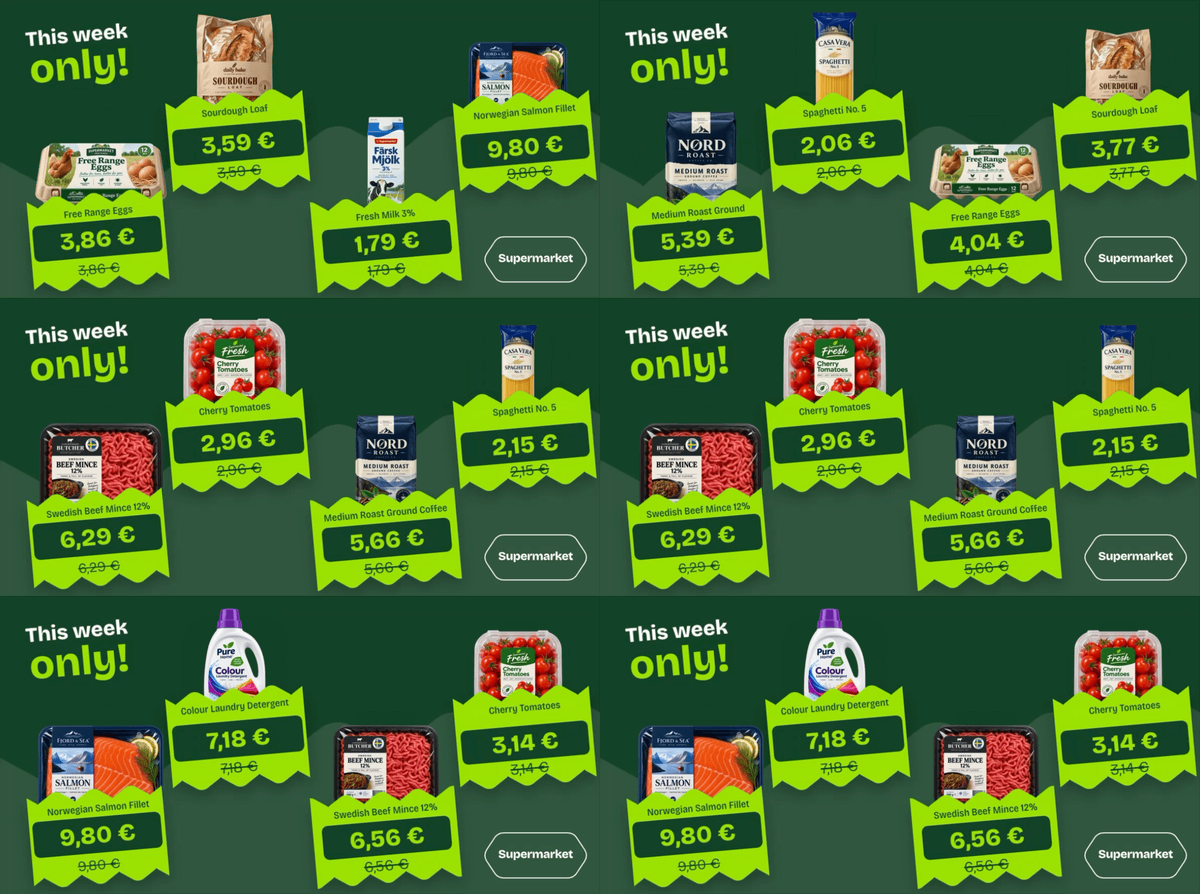
The Best Supermarket Ads, and the Ten Formats Behind Them
Advertising & Marketing Strategy
Why Supermarket Brands Use Bannerflow
Ad Technology & Automation
8 things to know about creative automation platforms
Ad Technology & Automation