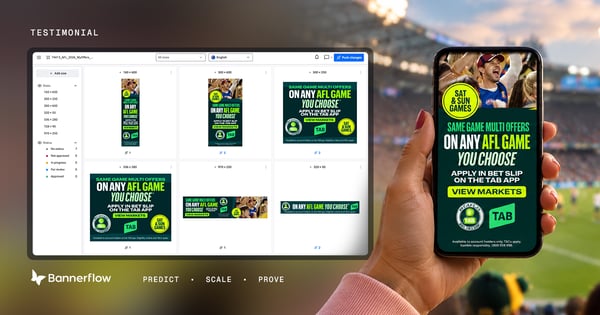
How Tabcorp turns hours of ad production into minutes with Bannerflow
Ad Technology & Automation
Guide
Display advertising has long proven its worth as a channel for reaching audiences across the full marketing funnel. Programmatic buying has reshaped the discipline, raising creative expectations and demanding more formats, versioning, and personalization than ever before. This guide examines its foundations, enduring relevance, and practical strategies for running campaigns with greater precision.

Display advertising remains an effective way to reach audiences at scale, supporting objectives ranging from awareness and consideration to retargeting and conversion.
The operational landscape has evolved significantly. Programmatic buying has expanded both reach and efficiency, while also elevating expectations for creative teams. Modern campaigns require a broader array of formats, greater versioning, enhanced localization, deeper personalization, and more frequent updates than in previous years.
This guide covers the basics of display advertising, looks at the current operational context, discusses its ongoing relevance, and highlights common challenges marketing teams face. It also presents practical strategies that enable marketers to create, scale, publish, and optimize campaigns more efficiently.
What is display advertising?
Display advertising is a digital marketing strategy that utilizes visual ad units to promote brands, products, and services across websites, applications, and digital platforms.
The key elements
Effective display advertisements integrate brand-aligned visuals, clear and persuasive copy, and a prominent call to action.
How to succeed
Successful display advertising campaigns identify target audiences, establish clear objectives and budgets, and ensure a seamless user experience from advertisement to landing page.
Display advertising is a form of digital advertising in which visual ad units, such as banners, rich media, and video ads, appear across websites, apps, and other digital platforms to drive awareness, engagement, and conversions. Display ads may be static, animated, interactive, or dynamic; however, their primary objective remains consistent: to communicate a clear message, attract attention, and prompt user action. In contrast to search ads, which address existing intent, display ads facilitate demand generation earlier in the customer journey, reinforce consideration, and re-engage users before conversion. The origin of the first banner ad is commonly attributed to HotWired in October 1994, as documented by Guinness World Records and Wired, featuring an early AT&T creative that established the format. While the fundamental concept of the banner ad remains unchanged, the scale, speed, and adaptability required of contemporary display campaigns have evolved significantly.
Display advertising no longer sits neatly at the top of the funnel. Today, it plays a role across awareness, consideration, retargeting, and conversion. As customer journeys become more fragmented across publishers, apps, social platforms, video environments, and connected devices, display helps brands stay visible and relevant across multiple touchpoints rather than relying on a single interaction. That matters because digital attention is increasingly distributed. WPP Media forecasts that pure-play digital will account for 73.2% of global ad revenue in 2025, underlining how far budgets have shifted toward digital channels and why display remains a foundational part of most modern media plans. Display remains especially valuable for three reasons:
Display campaigns can appear across publishers, platforms, devices, and regions through programmatic buying and automated delivery. EMARKETER estimates that programmatic will account for nearly nine in ten digital display ad dollars worldwide in 2025, making automated buying the dominant way to transact display inventory.
Modern display includes far more than static banners. Brands can use HTML5, dynamic creative, video, rich media, and interactive formats depending on the role the campaign needs to play. The IAB New Ad Portfolio reflects this shift by pairing flexible formats with lightweight guidance designed to support faster, less disruptive ad experiences.
Display is one of the few channels that can support broad awareness, repeated visibility, audience-specific relevance, and conversion-focused retargeting within the same operating model. It is especially effective when creative, frequency, and landing-page experience are managed as part of a single coherent journey rather than as isolated steps.
Programmatic advertising has made media buying faster, more scalable, and more precise. But it has also dramatically increased the creative demands placed on marketing teams. Campaigns now require more sizes, more audience variations, more localized versions, and more frequent updates to stay relevant. This creates a structural mismatch in modern display advertising: media can scale instantly, but creatives often cannot. Teams that still rely on manual workflows struggle to keep pace with the volume, speed, and complexity of today’s campaigns. That is why display performance is no longer just a targeting or media-buying issue. It is also a creative-operations issue. The strongest teams are those that can scale production, maintain control, personalize effectively, and continuously improve creatives while campaigns are live.
Practical takeaway: Before investing in additional display volume, audit whether your team can realistically produce, localize, publish, and refresh creative at the pace required by your media plan.
Static banners were the original form of display advertising: simple image-based ads built as JPG, PNG, or GIF files. They established the foundation of digital advertising but offered little flexibility beyond basic imagery and text. Flash later expanded what banners could do by enabling animation and interactivity, but the format depended on a browser plug-in and became increasingly associated with security and compatibility issues. Adobe ended support for Flash Player at the end of 2020, and Google’s ads policy guidance documents the earlier shift away from Flash creatives on ad networks. HTML5 became the standard replacement because it works across modern browsers and devices without requiring plug-ins. In practice, that transition turned display ads from fixed creative files into more flexible units that can be updated, localized, measured, and repurposed far more efficiently.
Short answer: An HTML5 banner is a modern, code-based ad unit built with web technologies that can be animated, interactive, responsive, and dynamically updated in real time.
An HTML5 banner uses the same coding language that powers modern webpages. Built using the latest version of Hypertext Markup Language, HTML5 ads are dynamic, editable, and interactive, capabilities that static banners cannot match. In HTML5 ads, elements such as text, images, video, and JavaScript can be updated and optimized in real time, just as a webpage is managed. This makes HTML5 ideal for adapting creatives to different devices, screen sizes, and placements without having to manually rebuild each version. Because HTML5 banners are flexible and network-friendly, they are easy to publish across multiple ad networks. They also allow marketers to track user interactions, integrate live data, and update messaging in real time. For these reasons, HTML5 became the default standard for creating, scaling, and managing modern display campaigns.
Short answer: Display advertising works by designing a master creative, scaling it to required sizes, publishing it to networks or exchanges, and then continuously optimizing based on performance and user behavior.
To launch a successful display advertising campaign, marketers typically follow four key steps. Before getting started, it’s important to note that display ads perform best as part of a unified, omnichannel marketing strategy in which creative, messaging, and branding remain consistent across online and offline touchpoints.
Step 1: Design - The process begins with designing your master creative, the foundation for every size and variation in your campaign. Ideally, this is created using an HTML5 ad builder or a creative automation platform. Effective display ads almost always include:
While banners can be built manually from scratch, doing so requires extensive coding and design expertise. It’s also slow and repetitive, since each size must be developed separately, making manual production impractical for most teams.
Step 2: Scale - After designing your master creative, scale it to the various formats your campaign requires. Display campaigns rely on multiple sizes to ensure visibility across devices and placements. However, scaling manually can be extremely time-consuming. Each HTML5 banner must be coded and adjusted individually, and may be customized for specific ad networks. This repetitive work can take hours or even days. Modern creative workflows solve this issue through automated scaling, in which approved templates and automation handle repetitive resizing without forcing teams to manually rebuild each asset. That helps campaigns move faster while keeping quality and consistency intact across desktop and mobile formats. Designing for mobile first is considered best practice, as many consumers browse more frequently on mobile devices.
Step 3: Publish - Once your creative variations are complete, it’s time to publish. Each HTML5 banner must match the specifications of the ad network or ad exchange you’re using. Following standard size guidelines, such as those offered by Google, helps ensure your ads render correctly across devices. Uploading ads manually to every platform is another repetitive task best avoided. Connected publishing workflows and direct integrations can streamline this step, making it easier to update, control, and version campaigns from a single place rather than managing each file separately.
Step 4: After Publishing - Publishing is only the beginning. Effective display campaigns require ongoing analysis and optimization. Marketers should continuously review performance, track conversion rates, and A/B test variations to identify which images, messages, and formats drive the best results. It’s also essential to build a strong post-click landing page that visually aligns with your ads. A seamless transition between ad and landing page improves continuity, user experience, and campaign performance. Keep in mind that real-world display campaigns often involve additional layers beyond these four steps, including cross-team collaboration, translation and localization, scheduling, media buying, multivariate testing, and live ad optimization.
Short answer: Display ads can be published through ad networks, ad exchanges, programmatic platforms (DSPs), or through connected publishing workflows that reduce manual handoffs.
Publishing display advertising can be both straightforward and highly complex, depending on your media strategy. Because buying models and technologies vary so widely, it’s worth exploring different approaches to determine which method best aligns with your goals, budget, and in-house capabilities. Below are the four primary ways display advertising is published today:
Short answer: A display ad network aggregates inventory from many publishers and sells it to advertisers, acting as the middle layer between brands and websites.
A display ad network serves as the gateway between advertisers and the websites (publishers) where ads appear. Ad networks aggregate unsold ad inventory from multiple publishers, package it by audience segments or content themes, and make it available to advertisers. Some networks are extremely selective about the publishers they include, ensuring higher-quality inventory. Others are more flexible, offering broader reach but varying quality. Choosing the right network depends on your targeting needs, brand standards, and campaign objectives.
What Is an Ad Exchange?
Short answer: An ad exchange is a real-time marketplace where buyers and sellers trade individual ad impressions, often using programmatic technology.
An ad exchange functions like a digital trading floor for buying and selling ad inventory. Instead of purchasing inventory from a single network, advertisers can access inventory from multiple networks simultaneously. This marketplace-style environment allows advertisers to bid on impressions in real time, target specific audiences, and secure placements at competitive prices. Leading examples of ad exchanges include Google Marketing Platform and AppNexus.
What Is Programmatic Buying?
Short answer: Programmatic buying uses software, data, and real-time bidding to automate how display ads are bought and placed, rather than relying on manual negotiations.
Programmatic display advertising automates the buying, selling, and optimization of ad placements across exchanges. Instead of negotiating directly with publishers, marketers use AI and machine learning to make real-time bidding decisions. These buying transactions occur within milliseconds, the time it takes a webpage to load, making automation essential for speed and accuracy. Programmatic buying empowers marketers to deliver large volumes of highly targeted, measurable display ads at scale. As adoption continues to grow, programmatic has become the standard method for buying display inventory.
Short answer: A creative automation platform lets you push properly tagged HTML5 ads directly to networks, exchanges, or DSPs from one interface, simplifying trafficking and updates.
Connected creative workflows can simplify publishing by pushing approved HTML5 banners directly to selected networks or exchanges and reducing the need for repetitive exports and uploads. Each ad still needs the correct click tag and technical settings so publishers can register interactions and route traffic correctly. Centralized workflows help reduce errors here, which is important because small trafficking mistakes can compromise both delivery and measurement. For more advanced campaign types, additional steps may be required, such as retargeting setups, sequencing rules, frequency controls, or scheduling across multiple markets. But for most campaigns, the goal is the same: reduce manual handoffs so teams can move faster without losing control.
Short answer: The four core display campaign types are: brand awareness, lead generation, affiliate marketing, and retargeting, each supporting different stages of the funnel. Basic display advertising campaigns typically fall into four main categories. Each one supports different strategic objectives and plays a unique role within a comprehensive digital marketing approach.
Brand Awareness: Brand awareness campaigns are the most traditional form of display advertising. Similar to billboards or print placements, these campaigns focus on getting your brand in front of large, relevant audiences across the web. The primary goal is visibility, ensuring consumers recognize your brand wherever they browse. These campaigns are generally evaluated using broad metrics such as impressions and reach.
Lead Generation: Lead generation campaigns are designed to drive direct responses. They guide users toward taking action, whether that’s visiting a landing page, completing a form, exploring a product, or making a purchase. These ads often incorporate interactive components, such as product feeds, carousels, or search tools, to increase engagement. Performance is typically measured using cost-per-acquisition (CPA), click-through rate (CTR), and other conversion-focused metrics.
Affiliate Marketing: Affiliate marketing involves partnerships with publishers who promote an advertiser’s banners in exchange for a commission on conversions. Creatives designed for affiliate activity tend to be more attention-grabbing than standard display ads, using bold imagery, strong calls to action, and promotional incentives to drive clicks and maximize returns for both the publisher and the advertiser.
Retargeting: Retargeting aims to re-engage users who have already interacted with your site or shown interest in your products. The objective is to bring these users back to complete a meaningful action, whether that’s finishing a checkout, returning to a key product page, or becoming a repeat customer. Retargeting is a highly efficient middle- to bottom-funnel tactic, often serving as the bridge between intent and conversion.
Note: These categories represent foundational strategies. More advanced techniques, such as dynamic creative sequencing, behavioral journey retargeting, and dynamic creative optimization (DCO), take these concepts much further through automation and personalization.
Modern display advertising is no longer defined only by placements and formats. It is increasingly defined by how effectively brands can produce, personalize, localize, measure, and improve creative at scale. Six strategic shifts are shaping how strong teams operate today.
Fragmented production slows campaigns, weakens brand consistency, and creates unnecessary manual work. Centralized creative systems let teams build from shared templates, maintain approval control, and scale across formats or markets without rebuilding from scratch.
Personalization is no longer just a targeting issue. It is a creative-operations issue. McKinsey found that 71% of consumers expect personalized interactions, and 76% become frustrated when they do not receive them, raising the bar for brands trying to stay relevant across segments, contexts, and moments.
Localization is more than translation. It involves adapting language, visuals, offers, and tone to the local market context without sacrificing production efficiency or brand consistency. Teams that build localization into the creative system early are usually better equipped to scale globally later.
Display performance improves when teams can clearly see what is working across messages, formats, placements, and markets, then feed those learnings back into creative decisions. That means treating creatives as something to measure and improve systematically, rather than reviewing them only at launch.
Static display still has a role, but stronger campaigns increasingly rely on a mix of creative expressions, from simple coverage formats to richer, more adaptive executions. The IAB Tech Lab’s LEAN principles and lightweight ad guidance remain useful here: richer formats work best when they respect load times, user control, and the overall browsing experience.
The most effective teams no longer treat campaigns as isolated ad files. They build repeatable systems that make it easier to launch faster, refresh creative sooner, and keep campaign decisions connected to performance data over time.
A useful planning lens: If your media plan is becoming more automated but your creative process is still heavily manual, that gap is likely where cost, delay, and inconsistency are entering the system.
Short answer: You measure display advertising by tracking how often your ads are seen, how users engage with them, and how effectively they drive meaningful business outcomes, such as clicks, conversions, revenue, or brand lift. Once your campaign is live, continuous measurement is essential. Display performance varies by campaign type and intent, so the metrics you choose should always match your KPIs. A brand-awareness campaign, for example, won’t be evaluated using the same measurements as a retargeting campaign. Below is an overview of the key metrics used in display advertising, along with guidance on when they matter most.
Tip: Consistency is critical. Decide your KPIs before launching the campaign and stick to them. Make sure your analytics setup is accurate, transparent, and properly connected.
CTR is one of the most frequently referenced metrics in display advertising, but it’s also one of the most misunderstood.
Why CTR Matters: CTR measures the percentage of users who clicked on your ad after seeing it. It is a direct indicator of engagement and user intent. Because it responds strongly to creative quality, messaging, design, and placement, CTR is a valuable signal of creative performance.
Why CTR Varies So Much: There is no universal “good” CTR. According to Google Display Network benchmarks, the average CTR for display ads is between 0.05% and 0.08%, but actual performance varies dramatically depending on:
Static brand-awareness banners may see lower CTRs, while interactive or dynamic HTML5 creatives, such as travel ads with real-time pricing, can achieve significantly higher CTRs
CTR improves when teams can test creative faster, spot fatigue earlier, and refresh ads without lengthy rebuilds. In practice, a better workflow does not guarantee stronger results on its own, but it does make it easier to run cleaner tests, apply learnings faster, and keep live campaigns relevant.
Note: Larger ad formats (such as 728×90 leaderboard banners) often generate higher CTR due to their visibility and placement.
Optimizing before launch prevents costly setbacks and ensures display ads load quickly, look polished, and meet network standards. Here are the four main reasons this step matters:
Reason 1: Avoid Being Rejected by Ad Networks - Ad networks enforce strict creative policies. Common rejection triggers include:
Pre-optimizing your ads ensures smooth approvals and eliminates wasted production time.
Reason 2: Increase Speed and Efficiency of Your Ads - Heavy ads (typically 150 KB+) load slowly, interrupt the user experience, and underperform. The IAB’s LEAN guidelines emphasize:
Smaller, efficient creatives consistently achieve stronger engagement rates and better campaign performance.
Reason 3: Target Viewers with Refined Creative - Creative should always be informed by:
But even the best predictions aren’t perfect. Continual testing and optimization allow you to understand what resonates with real audiences, not just what theory suggests.
Reason 4: Save Time and Budget - Pre-optimization reduces:
By streamlining production and removing repetitive tasks, your team can focus on strategy and creative quality, ultimately improving ROI.
What Is the Best Practice for Optimizing Live Display Ads?
Publishing your display campaign is not the final step; it’s the beginning of ongoing optimization. High-performing brands treat live optimization as a continuous process, reviewing performance data, refining creative, and adapting to real-time market conditions. To optimize effectively, marketers should track campaign costs, assess conversion rates, and frequently test creative variations to determine which messages and visuals resonate most.
Conversion rate is one of the most important performance indicators for display campaigns. A “conversion” doesn’t always mean a purchase; it represents whatever action your campaign is designed to drive, such as:
Tracking conversion rates throughout the campaign helps you understand how effectively your ads are driving users toward your intended outcome.
The digital environment changes constantly. News cycles shift, competitors launch campaigns, demand fluctuates, and your ads must adapt in real time. Being able to update live ads quickly is now essential. When teams have connected workflows, they can:
Real-time agility protects spend, improves relevance, and enhances performance.
Never launch a display campaign without a high-quality post-click landing page. For best results:
A seamless transition increases user trust, strengthens relevance, and improves conversion performance.
Creative testing is one of the most effective levers for campaign improvement. With connected workflows, marketers can:
Advanced real-time optimization, once slow and expensive, is more accessible when teams reduce manual production bottlenecks and connect creative decisions to performance data.
A/B testing is the most widely used method for improving display advertising performance. By testing variations of the same creative, marketers can identify which visual or messaging elements drive better engagement and conversions.
A/B testing compares two nearly identical versions of the same display ad (Version A and Version B), with one creative element changed, such as a CTA, image, headline, or color. The variant that performs better becomes the new baseline, and the process is repeated with a new element. This systematic, incremental method consistently improves results while keeping creative decisions data-driven.
Bannerflow’s in-house experts outline a simple, proven six-step approach:
Best practice: Keep audiences separate and measure results using post-view conversions to maintain accuracy and transparency.
A/B testing strengthens your ability to:
With the right workflow, A/B testing becomes easier to run consistently and at a useful pace. Even smaller in-house teams can build stronger optimisation habits when testing, reporting, and creative updates are connected.
Short answer: You need transparent analysis so you can trust your performance data, optimize campaigns accurately, and make decisions that genuinely improve ROI. Without transparency, you’re optimising in the dark.
Transparent analysis is essential to understanding how your display campaigns truly perform. Without accurate, trustworthy data, marketers cannot evaluate success, optimize creatives, or make informed budget decisions. In a landscape where efficiency, agility, and ROI matter more than ever, transparency is non-negotiable.
Short answer: Transparency is based on having full confidence that your performance data is real, correct, and free from hidden manipulation, whether from partners, platforms, or internal workflows.
Transparency means having full confidence that the performance data you're seeing is real, complete, and accurate. It ensures you can trust:
For digital marketers, transparency is ultimately about trusting the numbers behind delivery, engagement, conversion, and spend. Without that confidence, it becomes much harder to optimize intelligently or explain performance clearly across teams. For digital marketers, transparency is the foundation of:
Without reliable, verifiable data, none of these outcomes is possible.
Achieving transparency starts with gaining greater control over your creative, media, and measurement processes. Below are two proven approaches used by high-performing marketing teams.
Step 1: Bring More of Your Marketing In-House.
Short answer: In-housing gives you direct access to the data, tools, and processes that drive performance, removing blind spots and providing full visibility.
In-housing has become a major driver of transparency. When production, analytics, and optimization sit inside the business, teams gain:
If full in-housing isn’t possible, transparency with agencies can still be improved by requesting:
These adjustments help eliminate data blind spots and improve collaboration.
Step 2: Use a Shared Creative Workflow or Platform
A shared creative workflow or platform can improve transparency across both production and live analytics. When teams work from a centralized system, they can:
Because centralized workflows streamline creation and deployment, they reduce delays and improve accuracy, making transparent optimization far easier.
Short answer: Transparent data drives better decisions, faster optimization, and higher ROI, making it a competitive advantage for modern marketing teams. When marketers have full visibility into their campaigns, they can:
Transparency empowers performance-driven decision-making. Without it, teams operate in the dark.
If you want to improve display performance without overcomplicating the channel, focus on three things first: audit the pace of your creative workflow, clarify which metrics matter at each stage of the campaign, and tighten the link between live performance data and creative decision-making. From there, the practical path is usually straightforward: simplify production, standardize what can be standardized, and reserve complexity for places where richer formats or personalization will make a measurable difference.
1. What is display advertising in digital marketing, and how does it actually work? Display advertising is the use of visual ad units (banners, rich media, video) placed on websites or apps to promote a brand, product, or offer. You design a master creative, scale it into standard sizes, publish it via networks/exchanges/DSPs, and then monitor performance to optimize creatives and targeting over time.
2. What are the main types of display advertising campaigns, and when should I use each one?
The four core types are: brand awareness (for broad visibility), lead generation (for direct responses and conversions), affiliate marketing (for partner-driven sales on commission), and retargeting (for bringing back visitors who already showed interest). Most brands use a mix of all four across the funnel.
3. What is the difference between static banners, HTML5 banners, and rich media ads?
Static banners are simple image-based ads (.jpg, .png, .gif) with no animation or interactivity. HTML5 banners are code-based, responsive, and can be animated or interactive. Rich media is a more advanced use of HTML5 that adds deeper interactivity, motion, and sometimes video or audio to create more engaging experiences.
4. How does programmatic display advertising differ from using a simple ad network?
An ad network bundles inventory from specific publishers and sells it as packages. Programmatic display uses technology (DSPs, ad exchanges, RTB) to bid on individual impressions in real time across many networks and publishers. It offers more precise targeting, better scale, and automated optimization compared to manually buying from a single network.
5. What makes a display ad campaign successful in 2026? What should I focus on? Successful campaigns in 2026 combine strong creative (often rich media/video), mobile-first responsive design, smart use of programmatic and retargeting, a consistent brand experience across formats, and ongoing optimization through analytics, A/B testing, and automation. Teams that pair creative quality with data-driven iteration typically see the best ROI.
Ready to apply this? Here is where to see it in practice and what the data says.
Request a demo
The Bannerflow Blog
Ad Technology & Automation
Ad Technology & Automation
Ad Creativity

Advertising & Marketing Strategy

Ad Technology & Automation
Ad Technology & Automation